Learn how LRS and GIFT City work, the types of routes, the process, 2026 tax rules, and the credit risk in overseas stock investments that founders should watch.
Overseas Stock Investments from India: How the GIFT City Route Works in 2026

A true blue millennial trying to engineer her full time-career around the world of content. How cliché is that?
Table of Contents
| Summary Indians now send more money abroad to buy stocks and bonds than at any point in the past few years. Between January and August 2026, overseas equity and debt investment under the Liberalised Remittance Scheme (LRS) rose 86% to $2.61 billion. A big reason is GIFT City, which lets you buy US stocks through an Indian-regulated platform instead of opening a foreign brokerage account. This guide covers what overseas stock investing is, how the GIFT City route works, the four main ways to do it, the step-by-step process, the latest rule changes, and where credit and settlement risk sits. It is written for startup founders, online business owners and finance teams who want a clear picture before moving money or building products around it. |
The numbers behind the shift
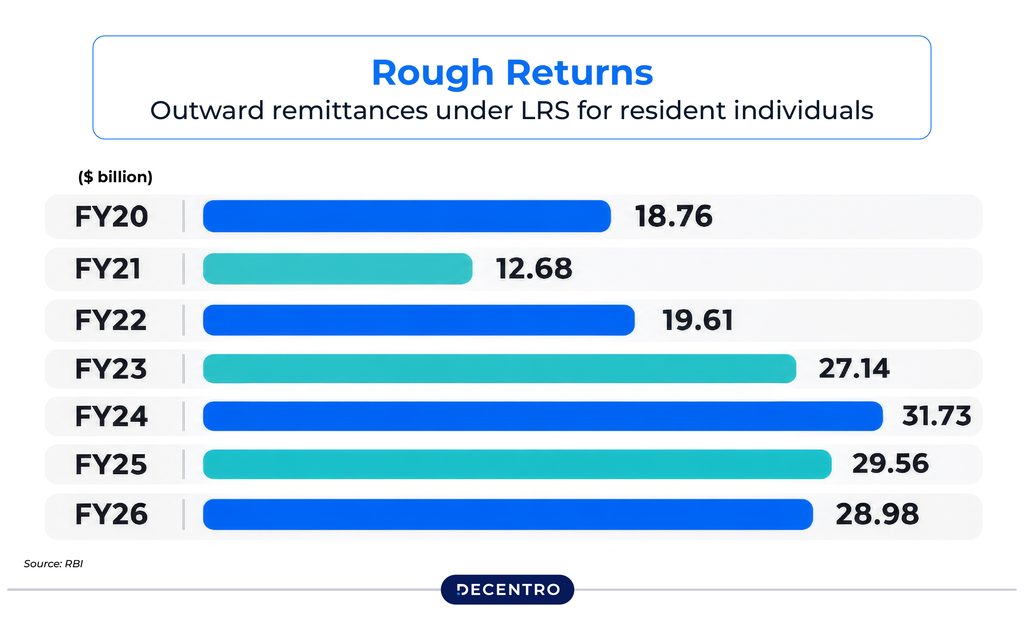
Start with the size of the opportunity.
- Resident Indians can remit up to $250,000 per financial year under LRS. The scheme began in 2004 with a limit of $25,000.
- Total LRS outflows were $28.98 billion in FY26, according to RBI data.
- From January to August 2026, outflows were $20.09 billion, up 5.26% on the year before (EcoNiti).
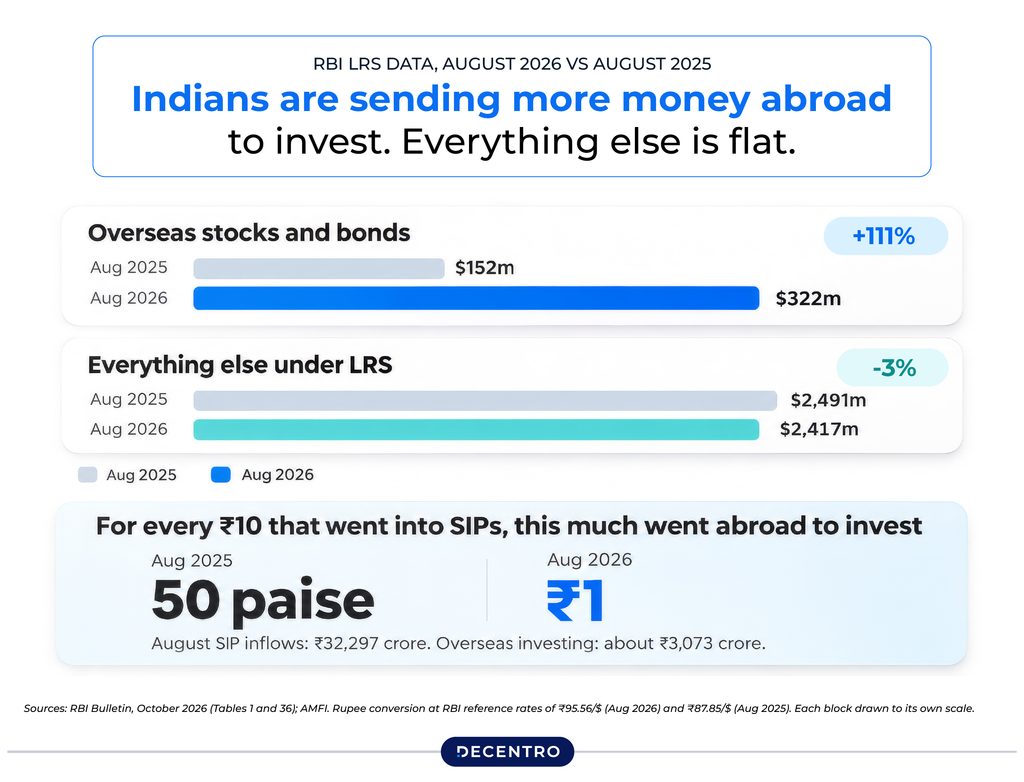
- In that same period, overseas equity and debt investment grew 86%, from $1.40 billion to $2.61 billion.
- In August 2026 alone, investment made up 11.7% of all LRS outflows, against 5.8% a year earlier (IANS).
- In June 2026, equity and debt remittances more than doubled year on year to $456.7 million (Business Standard).
Travel is still the biggest slice of LRS. But the mix is moving. More of the money leaving India is now going into portfolios, not holidays.
On the supply side, platforms have rushed in. INDmoney says it has served US stocks via GIFT City since August 2025 and reports over 3 million US stock accounts. Dhan and SAMCO Securities both launched GIFT City access in June 2026. Groww now offers 10,000+ US stocks and ETFs, with fractional buying from $1.
What is overseas stock investing?
Overseas stock investing means a resident Indian buys shares of a company listed outside India. Think Apple, Nvidia, Tesla, or an S&P 500 index fund listed in the US.
A simple way to see why people do it: imagine your whole portfolio is in one country. If that market has a slow year, everything slows down together. Owning companies from other markets spreads that risk. It also gives you access to businesses that have no Indian equivalent, such as the large AI and semiconductor firms.
For a founder, there are two common reasons to care:
- Personal diversification. Founders often have most of their net worth tied to one company in one country.
- Product opportunity. Fintechs, wealth apps and payment companies are building services for people who want global exposure.
All of this runs on one legal base, the Liberalised Remittance Scheme. LRS lets a resident individual send money abroad for permitted purposes, including investing in foreign securities. The limit applies per person, per PAN, across every platform and bank. It is not a separate limit per app.
What is GIFT City and why does it matter here?
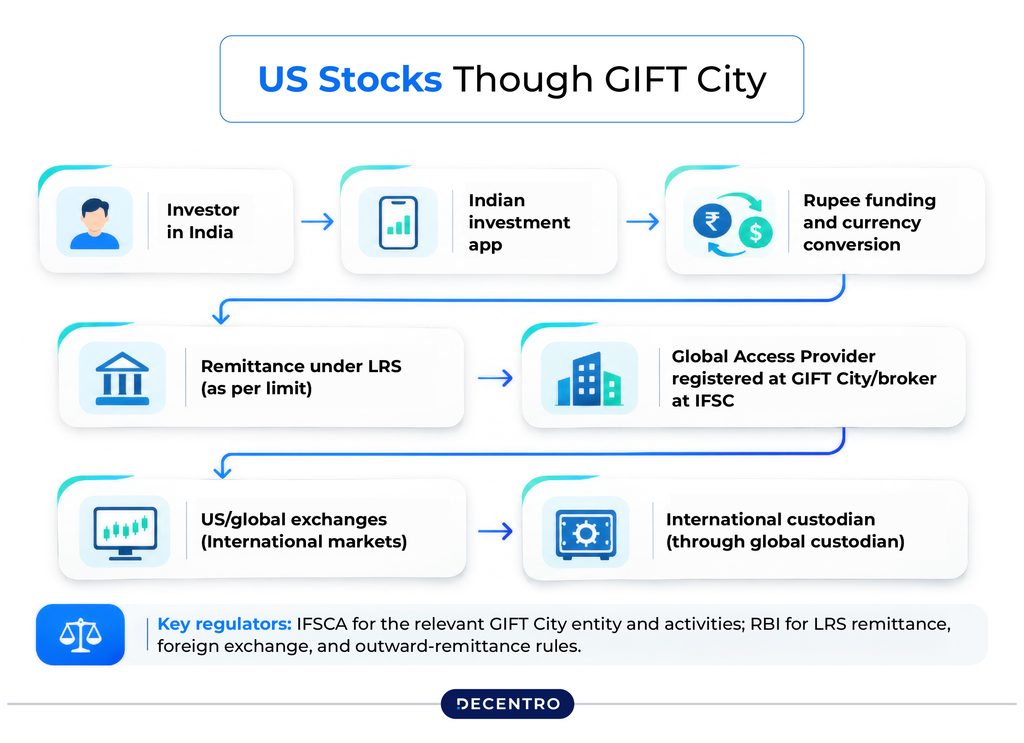
GIFT City, in Gujarat, is India’s International Financial Services Centre (IFSC). It is regulated by the International Financial Services Centres Authority (IFSCA), a separate regulator from SEBI.
Think of it as a small zone inside India where global financial business follows its own rulebook. Platforms licensed there can offer international products to Indian residents without the investor having to deal with a foreign broker directly.
The key licence is the Global Access Provider (GAP). A GAP holds relationships with regulated US clearing and custody firms and is accountable to IFSCA. An Introducing Broker is different. It registers with IFSCA but plugs into a GAP’s infrastructure for execution and custody. Both are regulated, but the number of parties between you and your shares is different, which affects cost, speed and who is responsible when something goes wrong.
Here is how the GIFT City route usually works:
- You open an account on a licensed platform with Indian KYC (PAN and Aadhaar).
- You fund a USD wallet through an LRS remittance from your Indian bank account.
- Your order goes to the US market and settles through US clearing institutions.
- Your shares sit with a US custodian, held at the DTCC, with you recorded as the beneficial owner.
- The platform keeps your books and reports to IFSCA.
On protection, platforms in this model say their US custody partners are SIPC members, which covers up to $500,000 per customer including $250,000 in cash. SIPC protects against a custodian failing. It does not protect against market losses.
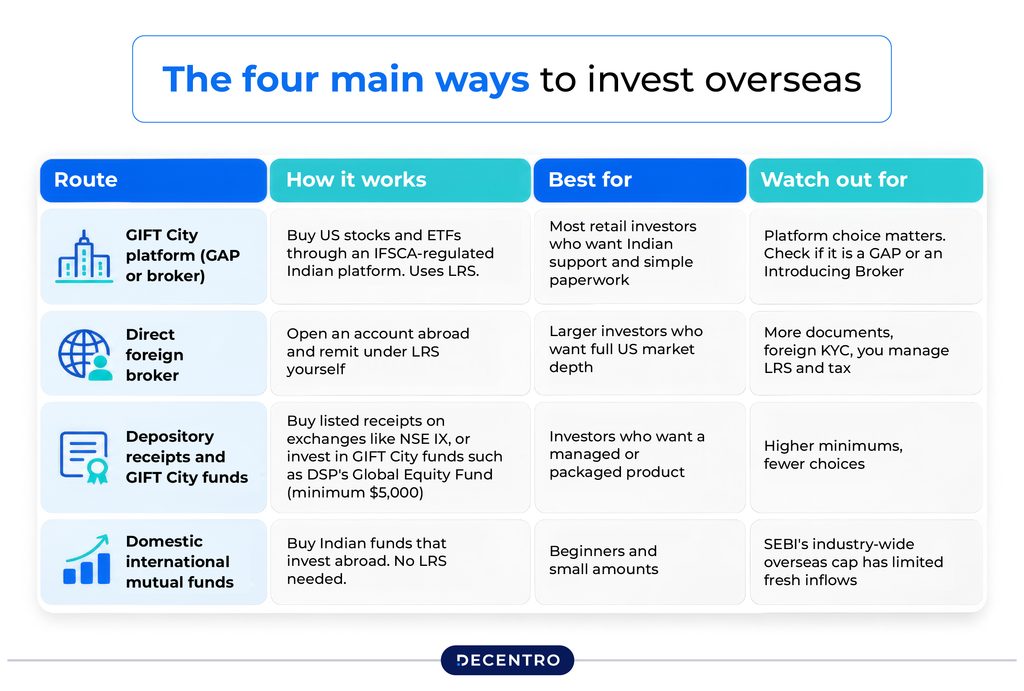
The four main ways to invest overseas
| Route | How it works | Best for | Watch out for |
|---|---|---|---|
| GIFT City platform (GAP or broker) | Buy US stocks and ETFs through an IFSCA-regulated Indian platform. Uses LRS. | Most retail investors who want Indian support and simple paperwork | Platform choice matters. Check if it is a GAP or an Introducing Broker |
| Direct foreign broker | Open an account abroad and remit under LRS yourself | Larger investors who want full US market depth | More documents, foreign KYC, you manage LRS and tax |
| Depository receipts and GIFT City funds | Buy listed receipts on exchanges like NSE IX, or invest in GIFT City funds such as DSP’s Global Equity Fund (minimum $5,000) | Investors who want a managed or packaged product | Higher minimums, fewer choices |
| Domestic international mutual funds | Buy Indian funds that invest abroad. No LRS needed. | Beginners and small amounts | SEBI’s industry-wide overseas cap has limited fresh inflows |
For most people starting out, the first route is the easiest. Setup usually takes a few days, and platforms handle the A2 form and currency conversion in the app.
How the process works, step by step
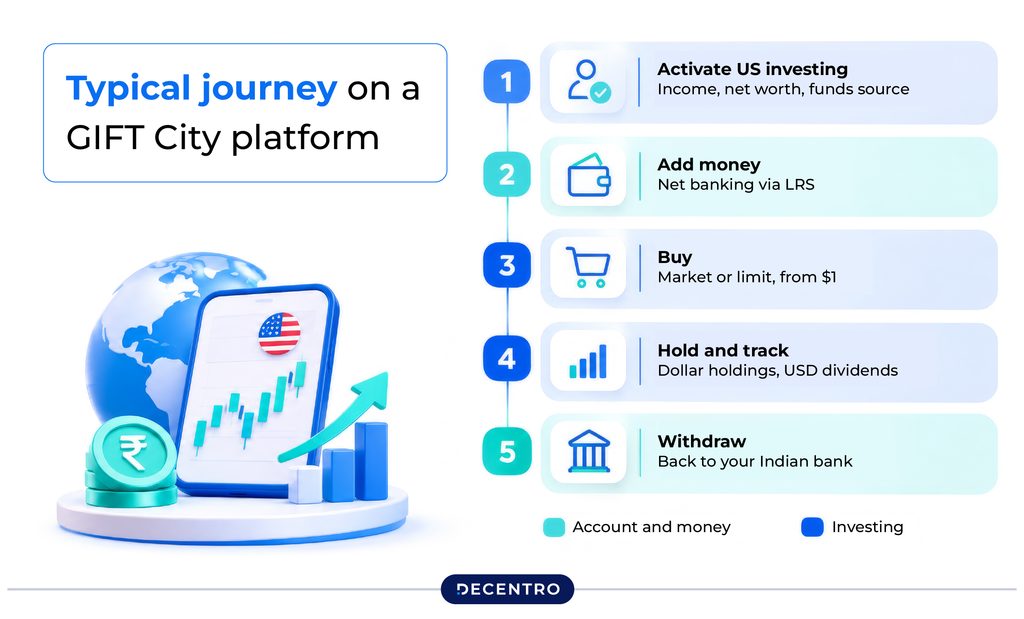
Here is a typical journey on a GIFT City platform. The details differ by app, but the pattern is the same.
Step 1: Activate US investing. Confirm your employment status, income bracket, net worth and source of funds.
Step 2: Add money. Choose your Indian bank account and pay through net banking under LRS. On Groww, for example, supported banks include HDFC, ICICI, IDFC FIRST, Axis and Kotak, with a minimum first deposit of $50.
Step 3: Buy. Place a market or limit order. Fractional shares let you start with as little as $1.
Step 4: Hold and track. Your holdings show in dollars, separate from your Indian stocks. Dividends are credited to your USD wallet.
Step 5: Withdraw. Sale proceeds come back to the same Indian bank account. Groww quotes 3 to 5 working days.
A real-world note on timing: the US market runs overnight in India. Under US standard time, which applies from November to March, trading runs roughly 8:00 PM to 2:30 AM IST.
Taxes and rules to know in 2026
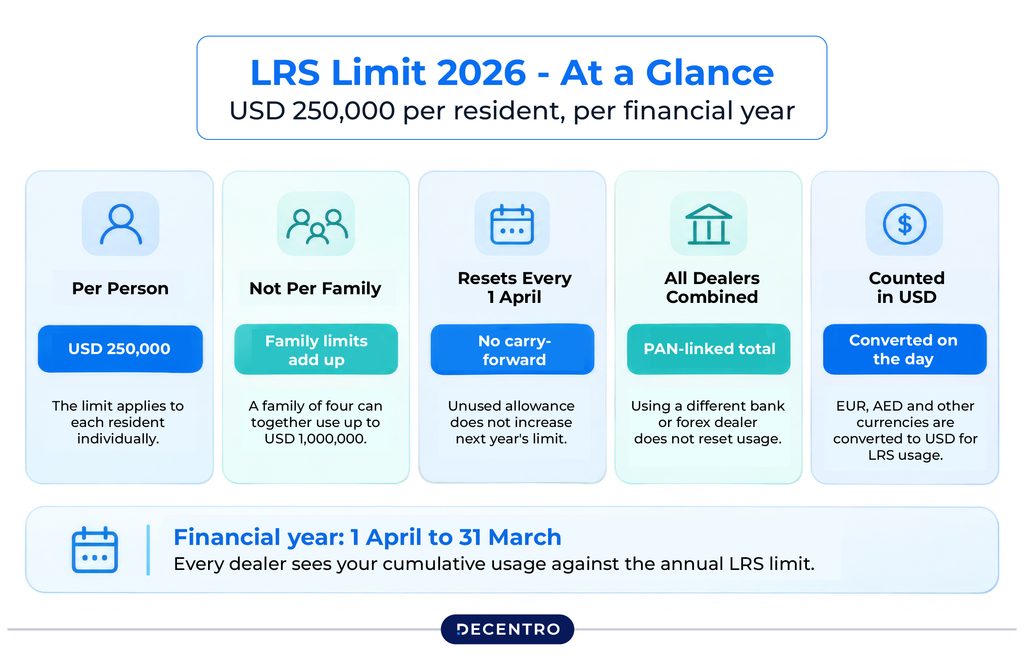
This is where many first-time investors get surprised. Here is the current picture.
TCS on LRS
Tax Collected at Source applies to LRS remittances above ₹10 lakh in a financial year. For investment purposes, the rate is 20% on the amount above ₹10 lakh. Budget 2026 cut TCS to 2% for education, medical and overseas tour packages, but the 20% rate for investments stayed the same.
A quick example. You remit ₹15 lakh in a year to fund US stocks. The first ₹10 lakh has no TCS. The remaining ₹5 lakh attracts 20%, which is ₹1 lakh. This is not an extra tax. It is credited to your PAN and can be adjusted against your income tax or claimed back when you file your return. The real cost is cash flow, since the money is locked up until then.
Dividends
The US withholds tax on dividends. Under the India-US tax treaty the rate is capped at 25% if you submit Form W-8BEN. Without it, the default is 30%. Example: 40 shares paying $0.80 each gives a $32 dividend. At 25%, $8 is withheld and you receive $24. You can claim a foreign tax credit in India using Form 67.
Capital gains
US shares count as long-term after 24 months, not 12. Long-term gains are taxed at 12.5% plus cess. Short-term gains are taxed at your slab rate. The ₹1.25 lakh exemption that applies to Indian equities does not apply here.
Reporting
If you are a resident and ordinarily resident, you must disclose foreign holdings in Schedule FA of your return, and report income in the relevant schedules.
How the LRS, TCS, and the A2 form work together
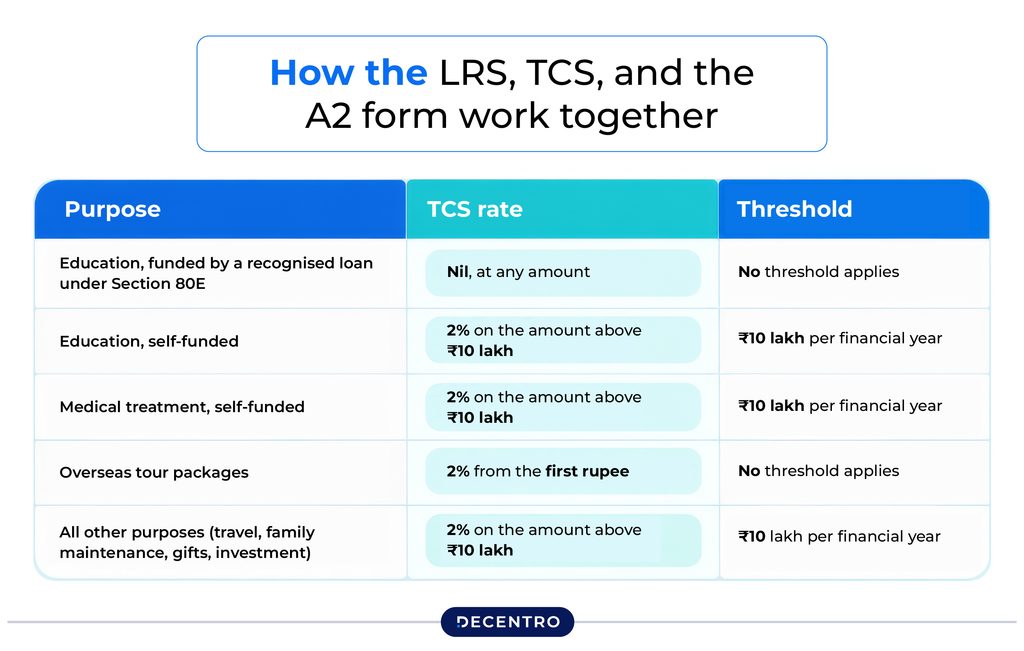
What to watch next. One report in November 2026 said the RBI is weighing curbs on LRS to contain outflows. It is reported, not confirmed. But with investment outflows doubling in places, anyone building a business on this flow should keep an eye on policy.
Tax rules change often. Check with a chartered accountant before acting.
Why this matters for founders and online businesses
If you run a startup, this trend touches you in three ways.
1. Your own money.
Founders hold concentrated, illiquid wealth. Overseas stocks are a way to diversify, as long as LRS limits and TCS are planned for.
2. Your product.
Wealth apps, neobanks, payment platforms and creator tools can all add cross-border features. Users want to send, invest and receive money across borders with less friction.
3. Your cash flow.
Remittance rules, bank cut-offs and settlement windows affect how fast money moves. A slow or unclear flow loses users.
Credit risk in overseas stock investments
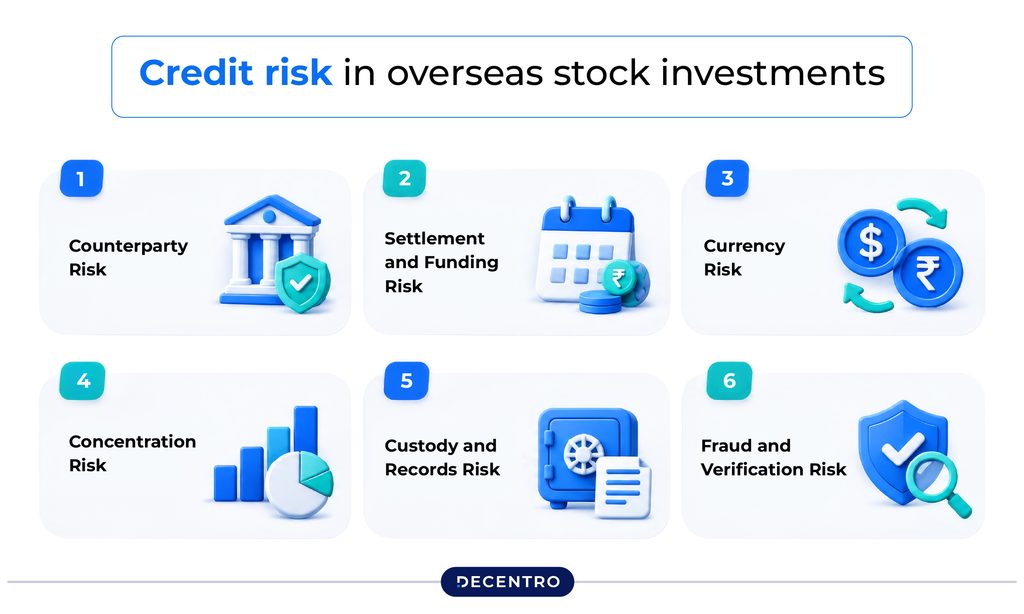
Most guides stop at taxes. For anyone building or running a platform, credit and settlement risk deserves equal attention. Here are the main places it shows up.
- Counterparty risk. Your money passes through a platform, a bank, a clearing firm and a custodian. If any one of them fails or delays, the investor feels it. Fewer hops usually means fewer failure points.
- Settlement and funding risk. LRS transfers can take time. If a platform lets users trade before funds actually arrive, it takes on exposure until settlement completes. That is a credit decision, whether the platform calls it one or not.
- Currency risk. The rupee moves against the dollar. A good stock return can shrink after conversion. Markups on exchange rates add a hidden cost.
- Concentration risk. Many new investors buy a handful of popular tech names. If those fall together, so does the portfolio.
- Custody and records risk. Check who holds the shares and who keeps the books. SIPC covers custodian failure, not falling prices.
- Fraud and verification risk. Weak KYC, mismatched bank accounts and mule accounts are an ongoing problem in any remittance flow. Matching the payer’s bank account to their identity is basic hygiene.
For platforms that offer instant credit, margin or buy-now features around global investing, risk management needs to be built into the product from day one. That means real-time checks on who the customer is, how much exposure they carry, and whether funds have actually settled.
Where Decentro fits in
Behind every overseas investing app is a stack of payment and compliance plumbing. Decentro builds that layer.
For overseas stock investing, that means LRS payment flows through netbanking with the bank’s own compliance journey, payment links that guide customers through each step, bank reference capture and automatic reconciliation so you know when a remittance has actually landed, and callbacks to your system when the status changes. Decentro’s GIFT City licence extends this to platforms that want to serve the IFSC route without having to build the infrastructure themselves.
If you are planning a global investing product, or want to add cross-border payments to an existing one, talk to the Decentro team about LRS and GIFT City.
Conclusion
Overseas stock investing from India has moved from a niche activity to a mainstream one. LRS gives the legal base, GIFT City gives a regulated Indian route, and falling friction has brought millions of new investors in. The numbers show it: investment outflows are growing faster than any other major LRS category.
For investors, the basics are simple. Know your $250,000 limit, plan for the 20% TCS above ₹10 lakh, submit your W-8BEN, report your foreign assets, and pick a platform with a clear structure and short chain of custody. For founders and platform builders, the opportunity is large, but so are the risks around settlement, verification and policy change.
Build on solid rails, manage credit risk early, and keep an eye on the RBI. The companies that get this right will be the ones people trust with their money across borders.
Frequently Asked Questions
Is it legal for Indians to buy US stocks?
Yes. Under LRS, resident individuals can remit up to $250,000 per financial year for permitted purposes, including foreign investments.
Do I need a US brokerage account?
No. IFSCA-licensed GIFT City platforms let you buy US stocks with Indian KYC.
How much TCS will I pay?
None up to ₹10 lakh in a financial year. Above that, 20% on the excess, which you can adjust against your income tax.
What is the minimum investment?
Some platforms allow fractional buying from $1, though first deposits can be higher. Groww asks for $50.
Are my shares safe if the platform fails?
Shares sit with US custodians, usually SIPC members, with cover up to $500,000 per customer. This does not cover market losses.