A definitive guide to the top trade finance companies, covering India’s fastest-growing fintech platforms and the global banking giants shaping the future of cross-border commerce.
12 Best Trade Finance Companies in 2026

A true blue millennial trying to engineer her full time-career around the world of content. How cliché is that?
Table of Contents

What Are Trade Finance Companies?
Trade finance companies are financial institutions, fintech platforms, and banking entities that provide structured financial instruments to facilitate domestic and international trade. These instruments (letters of credit, invoice discounting, supply chain finance, export factoring, and working capital loans) exist to bridge the trust and liquidity gap between buyers and sellers separated by borders, currencies, and time zones.
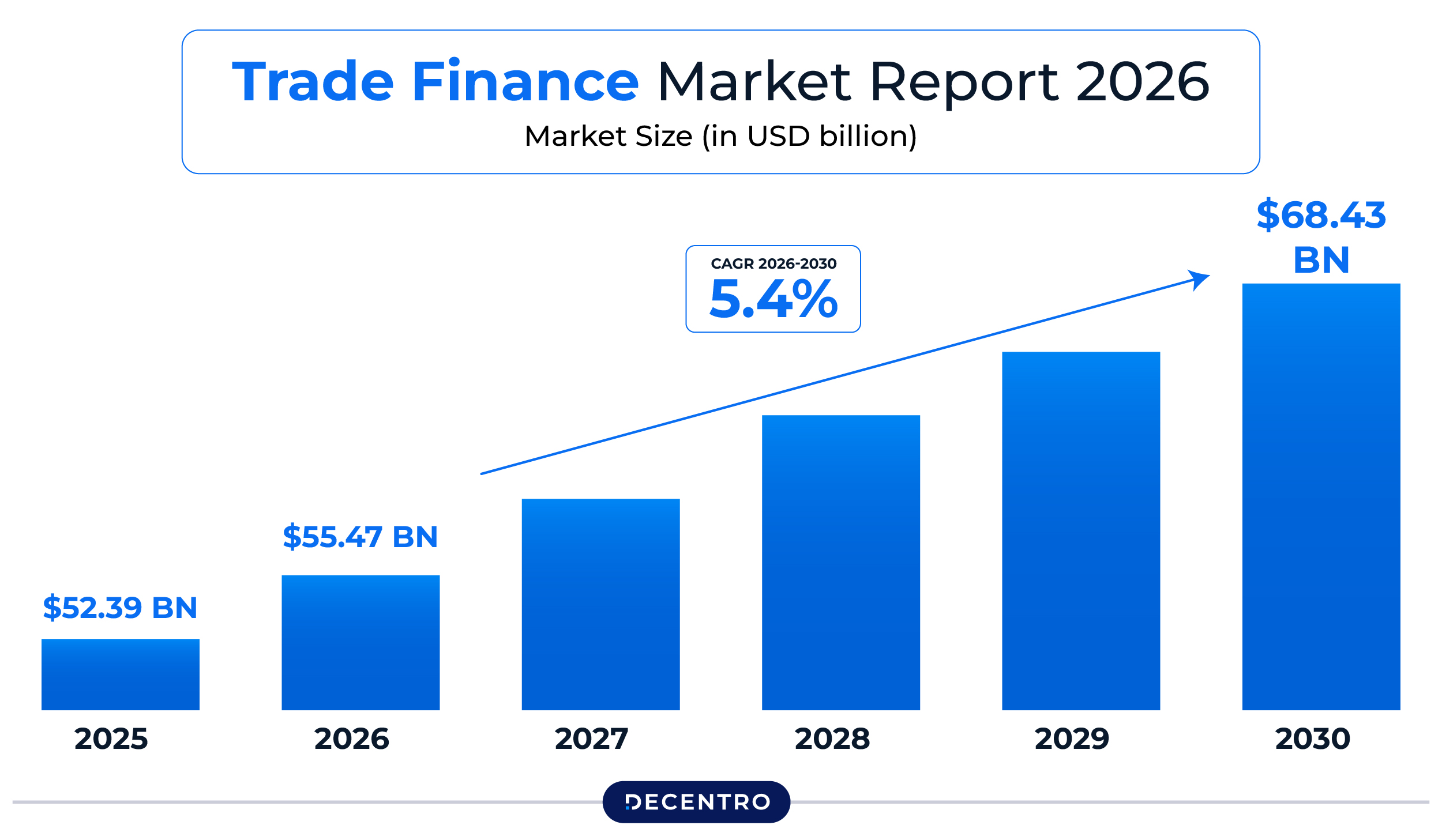
Global trade finance is a multi-trillion-dollar market. The global trade finance market was valued at approximately USD 52.23 billion in 2024 and is expected to reach USD 86.56 billion by 2035, growing at a CAGR of 4.70%. In India specifically, the trade finance market was valued at USD 2.72 billion in 2025 and is projected to reach USD 4.09 billion by 2031 at a CAGR of 7.05%, driven by MSME financing digitisation, government export schemes, and platforms like TReDS.
For Indian exporters, importers, and supply chain businesses, the trade finance gap remains a critical challenge. MSMEs account for nearly 40% of India’s total exports yet often face persistent barriers to credit access. This is why platforms like Vayana, Drip Capital, CredAble, and the TReDS ecosystems have become so strategically important.
In this guide, we cover the 12 best trade finance companies in 2026, with an emphasis on Indian players, examining their features, pros, cons, and market positioning to help you choose the right partner for your business.
A Quick Glance
Here is a bird’s-eye view of all 12 trade finance companies covered in this article:
| # | Company | HQ | Focus Area | Best For |
|---|---|---|---|---|
| 1 | Vayana Network | Pune, India | Supply Chain Finance | Mid-to-large enterprise ecosystems |
| 2 | Drip Capital | Palo Alto / Mumbai | Cross-border Trade Finance | Indian SME exporters & importers |
| 3 | CredAble | Mumbai, India | Working Capital Tech | Banks & enterprise SCF programs |
| 4 | M1xchange | Gurugram, India | TReDS Invoice Discounting | MSME invoice financing (domestic) |
| 5 | KredX | Bengaluru, India | SCF + B2B Payments | Enterprise receivables & payables |
| 6 | RXIL | Mumbai, India | TReDS (SIDBI + NSE) | PSU and public sector supply chains |
| 7 | Invoicemart | Thane, India | TReDS Invoice Marketplace | MSME exporters & government buyers |
| 8 | State Bank of India | Mumbai, India | Full-Spectrum Trade Finance | Large corporates & PSUs |
| 9 | HSBC Global Trade Solutions | London / Global | Global Trade Solutions | Multinational corporates |
| 10 | Standard Chartered | London / Global | Emerging Market Trade Finance | Asia, Africa, Middle East traders |
| 11 | JP Morgan Chase | New York, USA | Institutional Trade Finance | Large corporates & FIs globally |
| 12 | BNP Paribas | Paris, France | Structured Trade Finance | Commodity & energy sector traders |
Exploring the 12 Best Trade Finance Companies in 2026
Vayana Network
HQ: Pune, India
Founded: 2009
Vayana Network is India’s largest supply chain finance (SCF) platform, facilitating over USD 30 billion in trade flows across 300,000+ enterprises spanning 3,000+ supply chains. Founded in 2009 and headquartered in Pune, Vayana enables businesses of all sizes, from large anchor corporates to long-tail MSMEs, to access affordable, collateral-free trade credit digitally. It has processed over 3 million transactions across 600+ cities and 2,000+ pin codes in India, with its network extending to 20 countries globally. In 2025, Vayana secured RBI-approved NBFC status, significantly expanding its direct lending capabilities. The company has raised USD 91.9 million across 9 funding rounds, backed by SMBC Asia Rising Fund, Chiratae Ventures, Jungle Ventures, and IFC.
Top Features
- Receivables Financing: post-invoice factoring for supplier payments
- Payables Financing: buyer-led early payment programs for suppliers
- GSP Services: e-invoicing and e-way bill generation (1 in 4 e-invoices in India processed by Vayana)
- Vayana TradeXchange (ITFS): cross-border trade finance via auction-based IFSCA platform
- Deep-tier supply chain financing for Tier 2 and Tier 3 suppliers
- Analytics and risk management dashboards for lenders and corporates
Pros
- India’s largest SCF platform with USD 30B+ in trade flows processed
- RBI-approved NBFC status (2025) expands direct lending ability
- Also India’s largest GST Suvidha Provider, processing 1 in 4 e-invoices nationally
- Extends financing to deep-tier suppliers and long-tail MSMEs often ignored by banks
- Strong institutional investor backing including SMBC, IFC, Chiratae, and Jungle Ventures
Cons
- Primarily India-centric; international presence still developing
- Onboarding complexity can be high for very small MSMEs
- SCF platform requires anchor corporate participation and is not a standalone MSME credit product
Market Position
India’s number one supply chain finance platform by volume, with over USD 30 billion in trade flows processed since inception and 300,000+ enterprises on the network. Vayana operates across 600+ cities and 2,000+ pin codes, giving it the largest MSME reach of any private SCF platform in India.
Drip Capital
HQ: Palo Alto, USA / Mumbai, India
Founded: 2015
Drip Capital is a leading digital trade finance and B2B commerce company that has reimagined access to cross-border working capital for small and medium businesses. Founded in 2015 by Pushkar Mukewar and Neil Kothari, both Wharton alumni with backgrounds at Goldman Sachs, Capital One, and BlackRock, Drip has facilitated over USD 8 billion in cross-border trade for 11,000+ businesses across 100+ countries. Its AI-native underwriting engine assesses creditworthiness using alternative data (invoice histories, shipment records, buyer profiles), enabling collateral-free financing of up to USD 3 million per SME. In FY2024-25 alone, Drip disbursed over USD 2 billion, with India among its largest markets. Total funding raised exceeds USD 528 million from backers including Accel, Sequoia, Y Combinator, Sumitomo Mitsui Banking Corporation, IFC, Barclays, TD Bank, and East West Bank.
Top Features
- Post-shipment Export Receivables Financing for Indian exporters
- Buyer Finance Programs for US and North American corporates
- Import Supply Chain Finance for domestic buyers and their supplier networks
- AI-powered risk assessment and automated underwriting with 100+ automated checks
- B2B Commerce Platform connecting global buyers and suppliers
Pros
- Collateral-free financing of up to USD 3 million per SME, which is rare in India’s SME lending space
- USD 8B+ facilitated globally across 11,000+ businesses in 100+ countries
- Fast, data-driven credit decisions powered by AI-native underwriting
- Strong global capital partner network including Barclays, IFC, TD Bank, and East West Bank
- Serves all stages of trade, including export receivables, import supply chain finance, and domestic SCF
Cons
- Focused on SMEs, so large enterprise clients are better served by traditional banks
- Discount rates on receivables may be higher than bank-rate facilities
- Primary markets remain India, US, and Mexico, with limited coverage in other regions
Market Position
Drip Capital has financed over USD 8 billion in global trade since inception, supporting 11,000 SMEs across 60+ countries. In FY24-25, it disbursed over USD 2 billion, an industry-leading figure for a fintech trade finance platform focused on SMEs. It is one of the most well-capitalised digital trade finance platforms globally, with USD 528M+ raised.
CredAble
HQ: Mumbai, India
Founded: 2017
CredAble is India’s largest working capital tech platform, enabling over USD 11 billion annually in working capital across Indian corporate ecosystems. Founded in 2017 by Ram Kewalramani, Rajiv Ramnarayan, and Nirav Choksi, CredAble operates as a B2B SaaS and embedded finance company powering supply chain finance programs for 175+ large corporates, 400,000+ MSME borrowers, and 35+ financial institutions including Axis Bank, SIDBI, and Citibank. Notably, CredAble won the ‘World’s Best Software Provider for Supply Chain Finance’ at the Euromoney Transaction Banking Awards 2025, a rare distinction for an Indian company on the global stage. The company has raised USD 62M+ across 10 rounds, with investors including Axis Bank, SIDBI, and RSH Global. CredAble also holds a global presence across India, Singapore, Indonesia, UAE, Norway, and the UK.
Top Features
- Early Payment Platform: enterprise payables finance for large corporates
- Receivables Financing Platform: invoice discounting and export financing
- Pre-Invoice Financing: purchase order-based working capital
- Trade Platform for commodity and structured trade finance including inventory and offshore structures
- Payments and Reconciliation Infrastructure integrated with ERPs and banking rails
- AI-powered invoice verification against GST DPI that automatically verifies 10+ critical fields
Pros
- Winner of the World’s Best Software Provider for Supply Chain Finance award at Euromoney 2025
- Powers India’s first securitisation of a pool of receivable loans under RBI’s SSA Direction
- Modular microservices architecture allows banks to embed specific functions without full overhaul
- Deep-tier supply chain financing enables banks to lend beyond first-level suppliers
- Global footprint across Asia, Middle East, and Africa with cross-border commodity finance
Cons
- Primarily B2B, so individual small business owners cannot access it directly without a corporate anchor
- Integration complexity with legacy bank systems can slow deployment timelines
- Less name recognition among MSMEs compared to direct-lending platforms like Drip Capital
Market Position
CredAble facilitates USD 11B+ in working capital annually and has been recognised as the world’s best SCF software provider (Euromoney 2025). The platform hosts 175+ corporate clients, 400,000+ SME borrowers, and 35+ financial institutions. Its valuation was last assessed at USD 176.32 million in November 2023.
M1xchange (Mynd Solutions)
HQ: Gurugram, India
Founded: 2017
M1xchange, operated by Mynd Solutions Pvt. Ltd., is India’s leading TReDS (Trade Receivables Discounting System) platform, licensed by the Reserve Bank of India in 2017. In the first 10 months of FY2025-26, M1xchange crossed ₹1 lakh crore (approximately USD 12 billion) in transaction throughput, a historic first for any TReDS platform within a single fiscal year. The platform has onboarded 70+ banks and NBFCs, 3,500+ corporate buyers, and 70,000+ MSMEs across 2,200+ cities. Its subsidiary M1 NXT is an IFSCA-regulated ITFS platform expanding into global factoring. M1xchange operates on a fully digital, collateral-free, without-recourse model, meaning MSME sellers bear no liability if the corporate buyer defaults.
Top Features
- RBI-regulated TReDS invoice discounting marketplace
- Real-time multi-lender competitive bidding for invoice financing
- Without-recourse factoring, which protects MSME sellers from buyer default
- 24-hour fund disbursement post invoice acceptance
- M1 NXT: IFSCA-regulated ITFS platform for global and cross-border factoring
- UFX (Unified Financing Xperience) for large corporates managing multiple SCF programs
Pros
- First TReDS platform to cross ₹1 lakh crore throughput in a single fiscal year (FY2025-26)
- Without-recourse financing fully protects MSME sellers from buyer default risk
- Real-time bidding by 70+ banks and NBFCs ensures competitive discount rates
- Funds disbursed within 24 hours of invoice acceptance, which is critical for MSME cash flows
- Union Budget 2026-27 tailwinds: mandatory CPSE participation and GeM integration will drive volumes
Cons
- Onboarding can be cumbersome for very small MSMEs unfamiliar with digital platforms
- Interest rate savings depend heavily on buyer credit profile
- CPSE adoption has historically been slow despite regulatory mandates
Market Position
M1xchange holds a dominant position in India’s TReDS ecosystem, with over ₹2.5 lakh crore (USD 30B+) facilitated since inception. It was the first TReDS platform to surpass ₹1 lakh crore in a single fiscal year (FY26). The total TReDS market is projected to exceed ₹2 lakh crore in FY2024-25, with M1xchange holding the largest share by MSME network size.
KredX
HQ: Bengaluru, India
Founded: 2015
KredX is a Bengaluru-based fintech company providing supply chain finance and B2B payment automation solutions for enterprises. Founded in 2015 by Manish Kumar and Anurag Jain, KredX has raised USD 33 million from investors including Tiger Global Management, Prime Venture Partners, and Peak XV Partners. The platform offers reverse factoring, dynamic discounting, import and export financing, and collections automation for large enterprise ecosystems and their MSME supply chains. KredX is also an IFSCA-licensed ITFS platform under the brand DTX for international trade finance. In 2025, KredX and SBI partnered to enhance digital supply chain financing in India. KredX has also acquired Hummingbill to strengthen its B2B payments and invoice management capabilities.
Top Features
- Reverse Factoring: buyer-led SCF programs for supplier financing
- Dynamic Discounting: treasury-funded early payment to suppliers
- Import and Export Financing for cross-border SME trade
- DTX by KredX: IFSCA-licensed ITFS for international invoice discounting
- B2B Payments and AR Automation covering collections and order-to-cash workflows
- Cash management and trade analytics dashboards
Pros
- IFSCA-licensed international trade finance platform (DTX) for cross-border factoring
- SBI partnership (2025) provides access to India’s largest bank distribution network
- Strong focus on B2B payment automation and accounts receivable management
- Dynamic discounting enables buyers to deploy treasury surplus for supplier support
- Collections automation reduces days sales outstanding (DSO) for enterprise clients
Cons
- Smaller MSME network compared to M1xchange and Invoicemart
- Less brand recognition among tier-2 and tier-3 city businesses
- Funding raised is modest compared to peers; may face capital constraints for large programs
Market Position
KredX has raised USD 33 million and operates across domestic TReDS, ITFS-based international trade finance, and enterprise B2B payment automation. Its SBI partnership (2025) meaningfully extends its reach into the public sector banking network. KredX is among the top three SCF platforms in India by funding and enterprise client base.
RXIL (Receivables Exchange of India Ltd.)
HQ: Mumbai, India
Founded: 2017
RXIL, or Receivables Exchange of India Ltd., holds the distinction of being India’s first operational TReDS platform, launched in 2017 as a joint venture between SIDBI (Small Industries Development Bank of India) and NSE (National Stock Exchange of India). Its institutional pedigree makes it the most trusted platform for MSME invoice discounting in India’s public sector and financial institution ecosystem. RXIL operates as a neutral digital marketplace where MSME sellers upload invoices, corporate buyers approve them, and multiple financiers bid to provide funding at competitive rates. The platform has facilitated over ₹1 lakh crore in cumulative transactions and is particularly well-suited for businesses supplying to government entities and PSUs.
Top Features
- RBI-licensed TReDS invoice discounting marketplace
- Multi-lender bidding for collateral-free MSME invoice financing
- Without-recourse factoring protecting MSME sellers from buyer default
- Integration with government and PSU procurement ecosystems
- Priority Sector Lending (PSL) classification for participating banks
- Real-time digital auctions with fund disbursement within 24-48 hours
Pros
- Institutional-grade trust as a JV between SIDBI (India’s apex MSME lender) and NSE (India’s premier exchange)
- Neutral marketplace with no parent bank affiliation, providing unbiased financing discovery for MSMEs
- PSL classification for bank disbursements improves lender participation
- Strong presence in PSU and government contract supply chains
- Multi-lender participation drives competitive interest rates
Cons
- Lower brand presence among private-sector MSMEs compared to M1xchange
- Platform UI and onboarding processes have been slower to digitise than private players
- PSU buyer onboarding has historically been slow due to bureaucratic processes
Market Position
RXIL is India’s first and most institutionally credible TReDS platform. As a JV of SIDBI and NSE, it is uniquely positioned for PSU and government supply chains. The platform has crossed ₹1 lakh crore in cumulative transactions. Banks’ disbursements on RXIL qualify for PSL classification, making it particularly attractive to public sector banks.
Invoicemart (A.TReDS Ltd.)
HQ: Thane, Mumbai, India
Founded: 2017
Invoicemart is one of India’s three RBI-licensed TReDS platforms, operated by A.TReDS Ltd., a joint venture between Axis Bank and mjunction services (a 50:50 venture of Tata Steel and SAIL). Launched in July 2017, Invoicemart has facilitated over ₹1 lakh crore in MSME invoice financing since inception. In FY2025, Invoicemart recorded total income of ₹91.61 crore (up from ₹56.04 crore in FY2024) and EBITDA of ₹43.74 crore, demonstrating strong profitability momentum. The platform serves 2,980+ buyers, 44,300+ MSMEs, and 71 financiers across 1,000+ cities and 6,500+ postal codes. It is the only TReDS platform running on AWS infrastructure and holds ISO 27001 certification for data security.
Top Features
- RBI-licensed TReDS invoice discounting marketplace
- Transparent auction mechanism with competitive bidding from 71+ financiers
- Without-recourse MSME invoice financing with no liability on the seller for buyer default
- ERP integration for large corporate buyers for seamless invoice verification
- AWS-based platform for high availability and data security
- Digital onboarding with step-by-step support for first-time MSME users
Pros
- Strong Axis Bank backing provides deep lender connectivity and credibility
- Only TReDS platform on AWS infrastructure, ensuring high reliability and scalability
- ISO 27001 certified for information security
- Strong profitability in FY25, with ₹43.74 crore EBITDA on ₹91.61 crore revenue
- Wide MSME reach: 44,300+ MSMEs across 6,500+ pin codes and 1,000+ cities
Cons
- SR Batliboi & Co. LLP resigned as auditor in FY25, which is a regulatory development worth monitoring
- Platform awareness among very small MSMEs still developing relative to M1xchange
- Government buyer onboarding pace has been a constraint for scale
Market Position
Invoicemart has crossed ₹1 lakh crore in cumulative throughput and generated ₹91.61 crore in revenue in FY2025, achieving ₹43.74 crore EBITDA. With 2,980+ buyers and 44,300+ MSMEs, it is one of the most commercially scaled TReDS platforms in India.
State Bank of India (Trade Finance Division)
HQ: Mumbai, India
Founded: 1955
State Bank of India is India’s largest public sector bank and one of the most significant trade finance providers in the country. SBI’s trade finance suite covers the entire spectrum of cross-border and domestic trade instruments, including letters of credit, bank guarantees, export credit, bill discounting, packing credit, and MSME supply chain finance. Notably, SBI is the first Indian public sector bank to register as a financier across all four IFSCA-licensed TReDS and ITFS platforms: RXIL, M1xchange, Invoicemart, and KredX’s DTX. SBI’s digital platform YONO Business enables corporate and MSME clients to process letters of credit, export bills, remittances, and advance payments entirely online. SBI also won the Financier Excellence Award for highest throughput on M1xchange TReDS in 2025.
Top Features
- Letters of Credit (import and export LC issuance and advising)
- Bank Guarantees: performance, financial, and advance payment guarantees
- Export Credit: pre-shipment packing credit and post-shipment bill financing
- TReDS participation across RXIL, M1xchange, Invoicemart, and DTX
- YONO Business: digital platform for trade finance, remittances, LCs, and advance payments
- Supply chain finance programs for anchor corporates and their MSME vendor ecosystems
Pros
- Registered on all four IFSCA-licensed ITFS platforms, giving it the broadest trade finance network of any Indian bank
- YONO Business digitises the entire trade finance lifecycle for corporates and MSMEs
- Winner of the Best Financier with Highest Throughput award on M1xchange TReDS (2025)
- Unmatched branch network and correspondent banking relationships for international trade
- Lowest cost of funds among Indian lenders, which translates into competitive trade finance rates
Cons
- Legacy systems mean slower processing compared to pure-play fintech platforms
- Bureaucratic processes can slow onboarding and credit approvals for smaller MSMEs
- Less innovation agility compared to fintech players like Drip Capital or CredAble
Market Position
SBI holds India’s largest trade finance book among public sector banks and is the highest-volume financier on M1xchange TReDS in FY2025. Banks hold 76.05% of India’s trade finance market, with SBI commanding the dominant share of the public sector segment. Its presence on all TReDS and ITFS platforms makes it the most broadly distributed trade finance lender in India.
HSBC Global Trade Solutions
HQ: London, UK (Global)
Founded: 1865
HSBC’s Global Trade Solutions (GTS) is consistently rated among the world’s top trade finance providers and is the clear leader in Asia-Pacific trade finance, which accounts for the majority of global trade volume. HSBC’s trade revenue for H1 2025 was USD 1.37 billion, growing year-on-year, driven by guarantees supporting infrastructure build-out and new supply chain configurations across Asia. In December 2024, HSBC and the IFC announced a USD 1 billion trade finance program to address the financing gap in 20 emerging markets across Africa, Asia, Latin America, and the Middle East. HSBC is also the first bank to offer interoperability via the Komgo Konsole API, enabling seamless connectivity with corporate clients. In India, HSBC expanded at GIFT City in January 2025, creating a full-service corporate and trade finance desk for the international market.
Top Features
- Letters of Credit, Documentary Collections, and Trade Guarantees
- Supply Chain Finance programs for large corporate and multinational buyer networks
- Receivables Purchase and Payables Finance solutions
- Komgo Konsole API for digital trade finance client connectivity
- ECA-backed structured trade finance for large infrastructure projects
- Sustainable Trade Finance including green trade and ESG-linked supply chain finance
Pros
- USD 1.37B in trade revenue in H1 2025, the highest of any global trade finance bank
- First bank to offer Komgo Konsole API interoperability for seamless client connectivity
- USD 1B+ trade finance program with IFC targeting 20 emerging markets (Dec 2024)
- Strongest Asia-Pacific trade finance franchise globally, critical for India-Asia trade corridors
- Expanded GIFT City presence (Jan 2025) for India-linked offshore trade finance
Cons
- Primarily serves large corporates and multinationals, with limited accessibility for Indian SMEs
- Significant ongoing restructuring (retail exit from multiple markets) creates uncertainty
- High minimum transaction sizes and complex documentation for smaller businesses
Market Position
HSBC is the world’s leading trade finance bank by revenue, with USD 2.67B in annual trade revenue (2024). Its Global Trade Solutions unit commands the largest share of Asia-Pacific trade finance, a region responsible for over 40% of global trade flows. Alongside Standard Chartered, it dominates trade finance in India-Asia-Middle East corridors.
Standard Chartered
HQ: London, UK (Asia, Africa & ME Focus)
Founded: 1969
Standard Chartered is the world’s leading emerging-market trade finance bank, with approximately 90% of its profits derived from Asia, Africa, and the Middle East, the very corridors that drive the bulk of India’s international trade. The bank is particularly strong in India-UAE, India-Singapore, India-UK, and India-Africa trade routes. In February 2025, Standard Chartered became the first international bank to formally adopt the ICC’s Principles for Sustainable Trade Finance. The bank is also pioneering trade finance asset tokenisation through Project Guardian and Project Dynamo, and has partnered with Partior for blockchain-based instant cross-border settlement. Standard Chartered had USD 464.5 billion in current deposits and USD 281 billion in current loans as of end-2024.
Top Features
- Letters of Credit, Guarantees, and Documentary Collections
- Supply Chain Finance: payables and receivables programs for large corporates
- Commodity Finance and Structured Trade Finance covering pre-export, inventory, and warehouse financing
- Trade Finance Asset Tokenisation via Project Guardian and Partior blockchain settlement
- Sustainable Trade Finance aligned with ICC ESG principles
- Open Account Trade and Receivables Purchase solutions
Pros
- Deepest emerging market network among international banks, critical for India’s export corridors
- First international bank to adopt ICC Principles for Sustainable Trade Finance (Feb 2025)
- Pioneering blockchain tokenisation for trade finance via Project Guardian and Project Dynamo
- Partior partnership enables instant blockchain-based cross-border settlement
- NSE-listed in India with strong regulatory and market relationships
Cons
- Significant regulatory and sanctions-related settlements in prior years may affect long-term trust
- Recent strategic restructuring, including the exit from retail banking in multiple markets, creates operational uncertainty
- Less accessible to Indian SMEs, as the bank primarily serves institutional and large corporate clients
Market Position
Standard Chartered is recognised as the world’s best bank for trade finance in emerging markets. The bank commands a strong position across APAC, Africa, and the Middle East, regions collectively representing USD 3+ trillion in annual trade flows. Its balance sheet of USD 464.5B in deposits and USD 281B in loans provides deep capital for large-scale trade finance transactions.
JP Morgan Chase

HQ: New York, USA
Founded: 2000
JP Morgan Chase is the world’s largest bank by total assets and one of the most significant trade finance providers for institutional clients and multinational corporates. Its trade finance offering is anchored by its Payments and Commerce Solutions division, which integrates letters of credit, export financing, trade loan facilities, and supply chain finance into its broader treasury management ecosystem. JP Morgan’s Kinexys platform (formerly the Onyx blockchain platform) is at the cutting edge of trade finance digitisation, enabling faster blockchain-powered cross-border payments, tokenised trade receivables, and smart-contract-driven LC automation. The bank has been consistently recognised as a leading global trade finance provider by Global Finance Magazine’s World’s Best Trade Finance Providers 2025 awards.
Top Features
- Letters of Credit: commercial LCs, standby LCs, and back-to-back LCs
- Export and Import Financing: pre-export loans and usance financing
- Supply Chain Finance: payables and receivables programs
- Kinexys: blockchain-based cross-border payments and tokenised trade asset settlement
- Trade Loan Facilities and working capital revolving credit lines
- Documentary Collections and trade risk management
Pros
- World’s largest bank by total assets at USD 3.9 trillion, providing unmatched capital depth for large-scale trade
- Kinexys blockchain platform enables tokenised trade receivables and smart-contract LCs
- Recognised at Global Finance’s World’s Best Trade Finance Providers 2025
- End-to-end treasury integration with trade finance embedded into cash and liquidity management
- Unparalleled global network for multi-currency trade settlement
Cons
- Primarily serves Fortune 500 companies and large institutional clients, with limited SME accessibility
- High complexity and documentation requirements for onboarding
- Pricing is typically less competitive for smaller transactions
Market Position
JP Morgan Chase is the world’s largest bank by total assets (USD 3.9 trillion as of 2024) and holds a leading position in global trade finance by revenue. Alongside HSBC and Citibank, it dominates the institutional trade finance segment. The Kinexys platform positions JP Morgan as the leader in blockchain-based trade finance innovation.
BNP Paribas
HQ: Paris, France
Founded: 2000
BNP Paribas is Europe’s largest bank and one of the world’s foremost trade finance providers, with a particularly strong franchise in structured and commodity trade finance. BNP Paribas Trade Solutions offers the full spectrum of trade instruments, from classical LCs and bank guarantees to structured pre-export finance, commodity warehouse financing, and ESG-linked supply chain finance programs. The bank has been recognised as a leading global trade finance provider by Global Finance Magazine in 2025. BNP’s trade finance franchise spans 68 countries, with a particularly strong presence in Europe, Asia, and the Middle East.
Top Features
- Letters of Credit, Standby LCs, and Bank Guarantees
- Structured Commodity Finance: pre-export, inventory, and warehouse financing
- Trade Receivables Purchasing and Forfaiting
- ESG-Linked Supply Chain Finance: sustainability-linked early payment programs
- Open Account Trade and Payables Finance
- Export Credit Agency (ECA)-backed medium and long-term financing structures
Pros
- Europe’s number one and world’s top-5 trade finance bank by volume
- Exceptional expertise in structured commodity finance covering energy, agriculture, and metals
- Strong ESG trade finance proposition with sustainability-linked LCs and supply chain programs
- Presence across 68 countries with deep expertise in emerging market risk mitigation
- Consistent recognition at Global Finance’s World’s Best Trade Finance Providers awards
Cons
- Less accessible to Indian SMEs and mid-market exporters, as the bank primarily serves large corporates
- Complex documentation and onboarding timelines typical of global banks
- France-based headquarters means limited local presence in India’s tier-2 and tier-3 markets
Market Position
BNP Paribas holds a top-5 global position in trade finance by volume and is Europe’s largest trade finance bank. The bank commands particularly strong positions in structured commodity trade finance across energy, metals, and agriculture, alongside ESG-linked supply chain programs. Across its 68-country network, BNP Paribas is a cornerstone of global trade finance infrastructure.
Conclusion: Choosing the Right Trade Finance Partner in 2026
The trade finance landscape in 2026 is richly layered. India’s fintech-driven platforms, including Vayana Network, Drip Capital, CredAble, M1xchange, KredX, RXIL, and Invoicemart, are democratising access to working capital for MSMEs that traditional banks have historically underserved. At the same time, global institutions like HSBC, Standard Chartered, JP Morgan, and BNP Paribas continue to power the large-ticket, institutional, and multi-currency trade flows that form the backbone of international commerce.
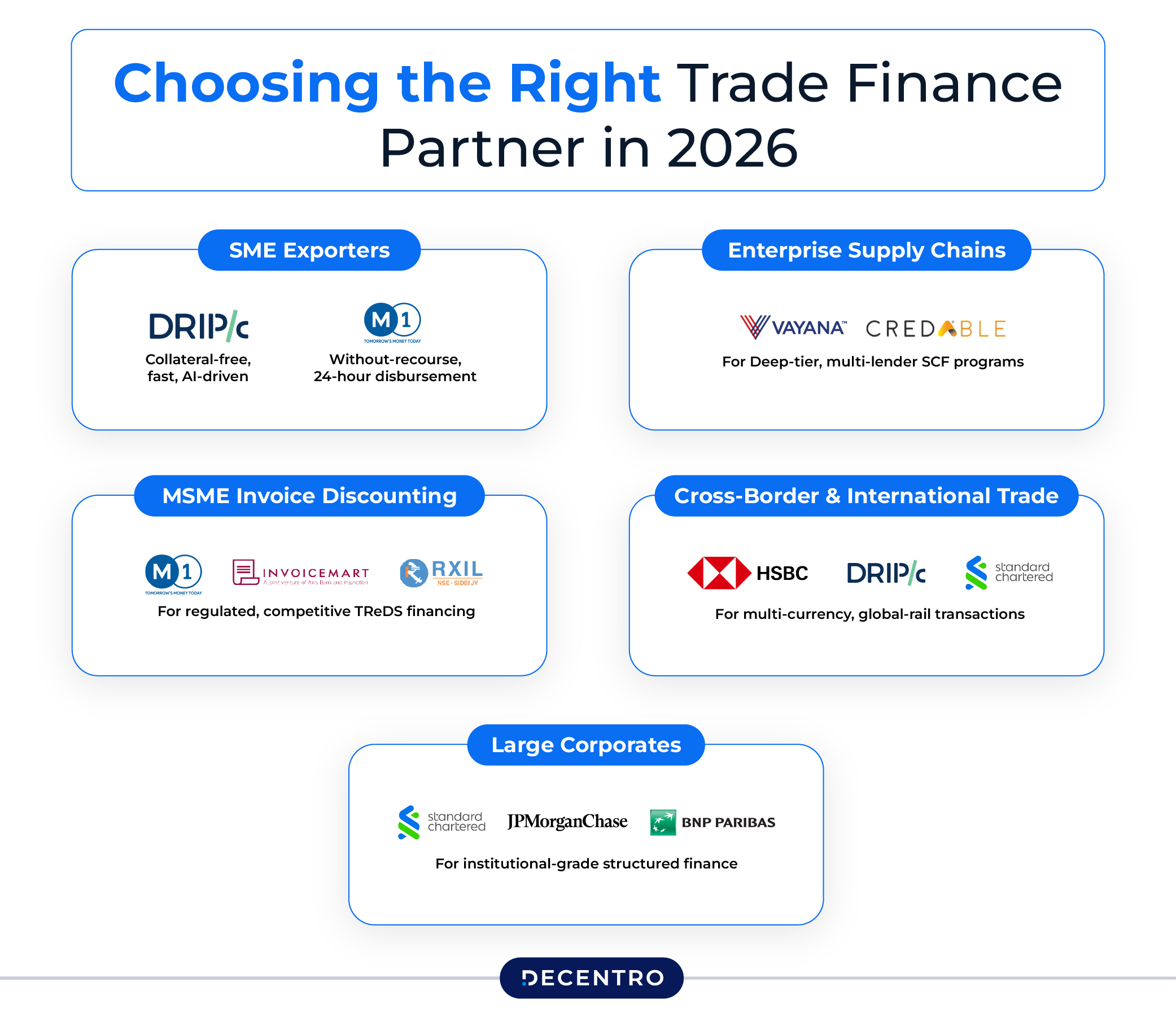
For Indian businesses, the choice often comes down to:
- SME Exporters: Drip Capital (collateral-free, fast, AI-driven) or M1xchange TReDS (without-recourse, 24-hour disbursement)
- Enterprise Supply Chains: Vayana Network or CredAble for deep-tier, multi-lender SCF programs
- MSME Invoice Discounting: M1xchange, Invoicemart, or RXIL for regulated, competitive TReDS financing
- Cross-Border & International Trade: HSBC GTS, Standard Chartered, or Drip Capital for multi-currency, global-rail transactions
- Large Corporates: JP Morgan, BNP Paribas, or Standard Chartered for institutional-grade structured finance
Regardless of which trade finance company you work with, one gap remains consistent across all these platforms: the need for fast, reliable, and transparent cross-border payment infrastructure to settle international receivables and disbursements.
One Gap That All Trade Finance Platforms Leave Open
Trade finance platforms help you structure and access credit. But once the financing is approved, someone still has to move the money across borders, in multiple currencies, through the right local rails.
That’s where most businesses run into friction. SWIFT delays, high correspondent banking fees, manual reconciliation, and opaque settlement timelines can undo a lot of the efficiency that fintech-driven trade finance is supposed to deliver.
Decentro’s Global Cross-Border Solution is built to close exactly that gap. Whether you’re an MSME exporter collecting USD from a US buyer, a supply chain platform disbursing to vendors in Singapore or the UAE, or a fintech embedding trade finance workflows into your product, Decentro gives you the payment infrastructure to move money the way modern trade demands.
What Decentro offers:
- Global Payment Acceptance via multi-currency virtual accounts. Buyers can pay you in SGD, USD, GBP, EUR, and 60+ other currencies directly, with settlement in your preferred currency
- Global Payouts to 170+ countries using local rails (FAST, PayNow, SEPA, ACH, Faster Payments) and SWIFT, reducing cost and turnaround time compared to traditional correspondent banking
- Ledger Management to reconcile cross-border trade flows, track receivables, and maintain a single source of truth for all international transactions
- API-first architecture with REST APIs and SDKs so your platform can embed global payments without heavy engineering overhead
- Dashboard access for non-technical teams to initiate, monitor, and reconcile cross-border payments without writing a single line of code
For businesses working with platforms like Drip Capital, Vayana, or M1xchange, Decentro fits in as the payments layer underneath, ensuring every cross-border receipt and disbursement is settled fast, recorded accurately, and reconciled automatically.
Frequently Asked Questions
What are trade finance companies?
Trade finance companies are financial institutions, banks, and fintech platforms that provide instruments and credit facilities, including letters of credit, invoice discounting, supply chain finance, and export factoring, to facilitate domestic and international trade by mitigating payment and counterparty risk.
Which is the best trade finance company in India in 2026?
The best trade finance company depends on your business type. For MSME exporters, Drip Capital or M1xchange are strong choices. For enterprise supply chain programs, Vayana Network and CredAble lead the market. For institutional-grade international trade finance, HSBC and Standard Chartered are globally recognised leaders.
What is TReDS and which are the TReDS platforms in India?
TReDS (Trade Receivables Discounting System) is an RBI-regulated electronic marketplace for MSME invoice discounting. India currently has three RBI-licensed TReDS platforms: M1xchange (Mynd Solutions), RXIL (SIDBI + NSE), and Invoicemart (Axis Bank + mjunction). There are also IFSCA-licensed ITFS platforms for international trade finance, including Vayana TradeXchange, M1 NXT, and DTX by KredX.
What is the size of India’s trade finance market in 2026?
The India trade finance market was valued at USD 2.72 billion in 2025 and is projected to grow to USD 4.09 billion by 2031 at a CAGR of 7.05%, according to Mordor Intelligence. Banks hold 76.05% of the market, with fintech platforms growing at over 10% CAGR, making it the fastest-growing segment.
How does Decentro’s cross-border solution help trade finance businesses?
Decentro’s Global Cross-Border Solution provides multi-currency virtual accounts, global payouts to 170+ countries using local rails (FAST, SEPA, PayNow, ACH), and a ledger management system for reconciliation. For businesses integrated with trade finance platforms, Decentro serves as the payments layer, ensuring every international receivable and disbursement is settled fast, recorded accurately, and reconciled automatically.