Explore India’s top 17 AgriTech startups in 2026 — from DeHaat to Stellapps. Compare AI-driven platforms, supply chain innovators & precision farming leaders shaping the future of Indian agriculture.
17 Top AgriTech Startups in India in 2026

A true blue millennial trying to engineer her full time-career around the world of content. How cliché is that?
Table of Contents

India’s agricultural sector is undergoing a quiet, powerful revolution. With over 140 million smallholder farming households and a $500 billion agriculture industry running on less than 1% tech penetration, the opportunity for agritech to create real-world impact is enormous.
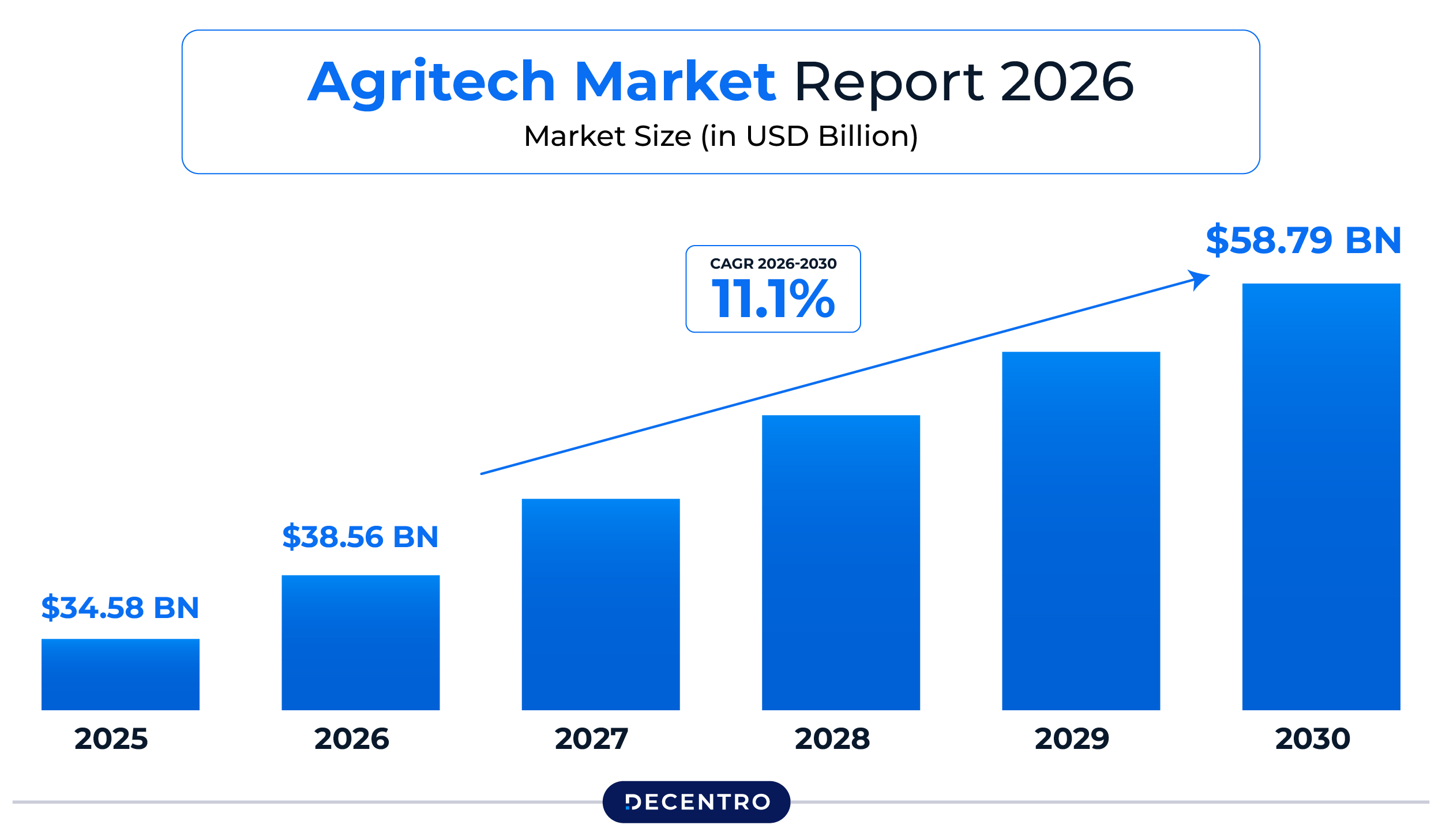
The Indian agritech market — valued at approximately $974 million in 2025 — is projected to reach $2.52 billion by 2034, growing at a CAGR of 10.59%. From precision farming and AI-powered advisory to supply chain digitisation and agri-fintech, the top agritech startups in India are rewriting the rules of farming.
This guide covers 17 standout agritech startups shaping Indian agriculture in 2026 — including their founding stories, features, pros, cons, and market positions.
A Quick Glance
| S.no. | Company | HQ | Focus Area | Best For |
| 1 | DeHaat | Gurugram, India | Full-stack agri services | Smallholder farmers across North & East India |
| 2 | Ninjacart | Bengaluru, India | Fresh produce supply chain | Retailers, restaurants & agribusiness buyers |
| 3 | AgroStar | Pune, India | Agri-input marketplace & advisory | Farmers in Gujarat, Maharashtra & MP |
| 4 | Arya.ag | New Delhi, India | Grain commerce & warehousing | Farmers & FPOs needing post-harvest finance |
| 5 | CropIn | Bengaluru, India | Farm data intelligence (SaaS) | Agribusinesses, banks & insurers globally |
| 6 | Fasal | Bengaluru, India | IoT precision farming | Horticulture farmers |
| 7 | Bijak | Gurugram, India | B2B agri-commodity marketplace | Agri traders & commodity buyers |
| 8 | AgNext | Chandigarh, India | AI-based quality assessment | Mandis, procurement centres & food processors |
| 9 | Intello Labs | Gurugram, India | AI & CV for agri supply chain | Agribusiness quality grading & wastage reduction |
| 10 | Unnati | Noida, India | Full-stack agri services (post-merger) | Farmers in MP & Rajasthan |
| 11 | FarmERP | Pune, India | Farm management software (SaaS) | Export-oriented agribusinesses globally |
| 12 | EM3 Agriservices | New Delhi, India | Farm mechanisation-as-a-service | Smallholder farmers need equipment access |
| 13 | AGRIM | Gurugram, India | B2B agri-input distribution | Rural agri-input retailers & manufacturers |
| 14 | BigHaat | Bengaluru, India | Agri-input e-commerce | Farmers across 28 states, esp South India |
| 15 | KhetiGaadi | Pune, India | Farm machinery marketplace | Farmers buying, selling & renting equipment |
| 16 | Stellapps | Bengaluru, India | Dairy tech & milk supply chain | Dairy co-operatives & processors (Amul, Mother Dairy) |
| 17 | Syngenta Digital (Cropwise) | Mumbai, India | Climate-smart agronomy SaaS | Agribusinesses & commercial farms globally |
DeHaat
HQ: Gurugram, Haryana | Founded: 2012 | Total Funding: $270M+
DeHaat (Green Agrevolution Pvt. Ltd.) is India’s most funded full-stack agritech platform, serving small and marginal farmers across 12 Indian states. Founded by Shashank Kumar, Shyam Sundar Singh, Amrendra Singh, Adarsh Srivastava, and Abhishek Dokania, DeHaat offers a complete suite of services — from agri-input procurement and expert advisory to credit facilitation and market linkages. In FY25, it crossed ₹3,000 crore in revenue (an 11% YoY increase) and reported a net profit of ₹369 crore. It exports to 32 markets, including the UK, Europe, and Southeast Asia, targeting ₹800 crore in export revenues in FY26. The company raised ₹200 crore in venture debt from Trifecta Capital in April 2025 and acquired agri-advisory app AgriCentral.
Top Features:
- End-to-end agri services: inputs, advisory, credit, and market linkages
- AgriCentral app for crop disease detection and expert advisory
- Drone-based farming services via partnership with Drone Destination
- Agrifood consumer brand for supply chain integration
- Export linkages to 32+ global markets
Pros:
- India’s largest agritech by revenue; crossed ₹3,000 crore in FY25
- First profitable year in FY25 (operational profitability path being pursued)
- Strongest funding pedigree in Indian agritech ($270M+, backed by Temasek, Sofina, Peak XV)
Cons:
- Operational profitability is still elusive without accounting for fair-value CCPS adjustments.
- Growth relies heavily on agri-input sales, which have thin margins.
- Presence concentrated in 12 states — pan-India scale yet to be achieved.
Ninjacart
HQ: Bengaluru, Karnataka | Founded: 2015 | Total Funding: $407M+
Ninjacart is India’s largest B2B fresh produce supply chain company, digitising the link between farmers, retailers, and restaurants using tech-enabled logistics and demand forecasting. Backed by Tiger Global, Walmart, and Flipkart, it serves thousands of farmers and connects them with urban retail buyers, reducing waste. In 2025, Ninjacart expanded into agri-fintech and lending services for farmers and buyers alike.
Top Features:
- Real-time demand-supply matching for fresh produce
- AI-powered inventory and logistics optimization
- Direct farm-to-retailer routing to eliminate intermediaries
- Embedded fintech for buyer credit and farmer advances
- Quality grading at the farm gate to reduce rejection rates
Pros:
- Largest-ever agritech funding at $407M+
- Backed by marquee investors, including Walmart and Flipkart
- Significant reduction in food wastage through tech-optimised cold chain logistics
Cons:
- The fresh produce supply chain is inherently capital-intensive and operationally complex.
- Profitability timeline remains extended due to high logistics costs.
- Concentration in metro and tier-1 cities limits rural farmer reach
AgroStar
HQ: Pune, Maharashtra | Founded: 2013 | Total Funding: $111M+
AgroStar is India’s largest digital farmer network and agri-inputs platform, serving over 5 million farmers across Gujarat, Rajasthan, Maharashtra, Madhya Pradesh, and Uttar Pradesh. It combines a digital advisory platform with an agri-input marketplace. In November 2025, AgroStar raised $30 million led by global climate investment firm Just Climate, signalling a strong pivot toward sustainable and climate-resilient agriculture.
Top Features:
- Digital advisory platform for crop disease and pest management
- Agri-input marketplace (seeds, fertilisers, pesticides, machinery)
- AgroStar app with vernacular language support for farmers
- Agronomist-on-call service for expert recommendations
- Climate-smart agronomy modules (post-Just Climate investment)
Pros:
- India’s largest farmer network with 5M+ active users.
- $30M fresh funding from Just Climate reinforces long-term sustainability vision.
- Strong distribution depth across Tier-2 and Tier-3 geographies
Cons:
- Revenue model dependent on agri-input e-commerce, which faces price competition from offline channels
- Reaching the “last mile” of rural India remains logistically expensive
- Competition from DeHaat and BharatAgri is intensifying in the advisory space
Arya.ag
HQ: New Delhi | Founded: 2013 | Total Funding: ~$115M (incl. ₹725Cr Series D)
Arya.ag is India’s largest integrated grain commerce platform, operating over 5.0 million tonnes of storage capacity across 5,500 warehouses in 21 Indian states. In January 2026, it raised ₹725 crore (~$80.6M) in a Series D round led by GEF Capital Partners, one of the largest agritech funding rounds of 2026. The platform reported ₹31.5 crore in profit for H1 FY26 and is deploying the capital to build 12,000 agri-warehouses and 100 Smart Farm Centres.
Top Features:
- Post-harvest storage: 5.5M+ tonne capacity across 5,500+ warehouses
- Warehouse Receipt Financing (WRF) for farmers to access credit against stored grain
- Smart Farm Centres for last-mile agri-services
- Climate-smart grain commerce tools to help farmers time their sales
- Integrated FPO (Farmer-Producer Organisation) engagement
Pros:
- Profitable business in H1 FY26, rare among Indian agritech startups
- Largest grain warehousing network in India with 5M+ tonne capacity
- ₹725 crore Series D in 2026 ranks among the largest recent agritech rounds
Cons:
- Warehouse infrastructure is capital-intensive with long payback periods.
- Strong dependency on commodity price cycles, which are volatile
- Currently focused on grain, diversification into other crops is still in the early stages
CropIn
HQ: Bengaluru, Karnataka | Founded: 2010 | Total Funding: $30M+
CropIn is a pioneering farm data intelligence company that transforms farm-level data into actionable insights for agribusinesses, banks, insurers, and governments. Founded by Krishna Kumar, CropIn’s AI-powered platform has digitised millions of acres of farmland globally and is used by over 250 agribusiness clients across 52 countries. Its flagship product, SmartFarm, provides end-to-end crop lifecycle monitoring using satellite imagery, IoT sensors, and machine learning.
Top Features:
- SmartFarm: crop lifecycle management and farm digitisation
- SmartRisk: AI-driven crop risk assessment for banks and insurers
- SmartAcre: satellite-based remote sensing for large-scale crop monitoring
- Agri Data Platform with real-time weather, soil, and crop intelligence
- Global coverage across 52 countries
Pros:
- First Indian agritech company to deploy AI at a global scale across 52 countries
- Trusted by 250+ agribusiness clients, including banks and governments
- Critical enabler for agricultural lending and crop insurance underwriting
Cons:
- The B2B SaaS model means direct farmer impact is indirect
- Scaling in fragmented markets with limited data infrastructure is challenging.
- Faces competition from global precision agriculture platforms
Fasal
HQ: Bengaluru, Karnataka | Founded: 2018 | Total Funding: $15M+
Fasal (Wolkus Technology Solutions) is an IoT-led precision farming platform designed specifically for horticulture crops such as grapes, tomatoes, pomegranates, and capsicum. Its proprietary IoT devices are deployed directly in the farm to capture real-time microclimate data, which is then analysed by its AI engine to provide crop-specific, time-sensitive recommendations.
Top Features:
- Farm-level IoT sensors for soil moisture, temperature, humidity, and leaf wetness
- AI-driven crop advisory based on real-time microclimate data
- Disease prediction models for high-value horticulture crops
- Integration with irrigation systems for automated water management
- Mobile app with actionable notifications for Indian smallholder farmers
Pros:
- Only Indian platform offering farm-level IoT advisory specifically for horticulture
- Demonstrated yield improvements of 20–35% in pilot deployments
- Strong appeal to progressive farmers in Maharashtra, Karnataka, and Andhra Pradesh
Cons:
- IoT hardware deployment has upfront cost barriers for small farmers
- Focused on horticulture — limited addressable market compared to staple crops
- Hardware maintenance and connectivity in rural areas remain challenges
Bijak
HQ: Gurugram, Haryana | Founded: 2019 | Total Funding: $35M+
Bijak is India’s leading B2B digital marketplace for agricultural commodities, connecting traders, processors, and buyers across the agri-value chain. By digitising the highly informal agri-commodity trading ecosystem, Bijak brings transparency in price discovery and trust in transactions for participants in mandis and commodity markets.
Top Features:
- Digital commodity marketplace connecting buyers and sellers across 30+ commodities
- Price discovery engine with real-time mandi data integration
- Trade financing solutions for agri-commodity buyers
- Business tools for small and medium agri-traders (invoicing, ledger, analytics)
- WhatsApp-based interface for low-tech rural traders
Pros:
- Digitising India’s vast and opaque agri-commodity trading network
- WhatsApp-based UX drives adoption among less digitally literate traders
- Growing B2B lending vertical adds a fintech revenue layer
Cons:
- Trust-building in informal agri-trading networks takes time and is geographically specific
- Faces competition from NCDEX, state APMCs, and other commodity platforms
- Revenue model is nascent — still proving unit economics at scale
AgNext Technologies
HQ: Chandigarh, Punjab | Founded: 2016 | Total Funding: Undisclosed (Series B)
AgNext is an AI and sensor-technology company that has built quality assessment solutions for agricultural commodities. Its flagship product, Qualix, uses spectroscopy, computer vision, and machine learning to instantly evaluate the quality of grains, spices, oilseeds, and dairy — replacing slow, subjective manual testing at procurement centres, mandis, and food processing plants.
Top Features:
- Qualix: instant AI-based quality testing for 30+ agri-commodities
- Deployed at grain mandis, procurement centres, and food processing units
- Portable and stationary device versions for field and lab use
- Integration with commodity trading platforms and government procurement systems
- Reduces quality disputes in agri-commodity trade by providing objective data
Pros:
- Solves a critical pain point: subjective quality assessment costs Indian farmers billions every year
- Deployed in government commodity procurement (FCI, state agencies)
- Strong IP moat in spectroscopy-based commodity quality testing
Cons:
- A hardware-dependent model requires significant deployment and maintenance investment
- Scaling across India’s 7,000+ mandis is a monumental challenge
- Revenue visibility and scale metrics are not publicly disclosed
Intello Labs
HQ: Gurugram, Haryana | Founded: 2016 | Total Funding: $13M+
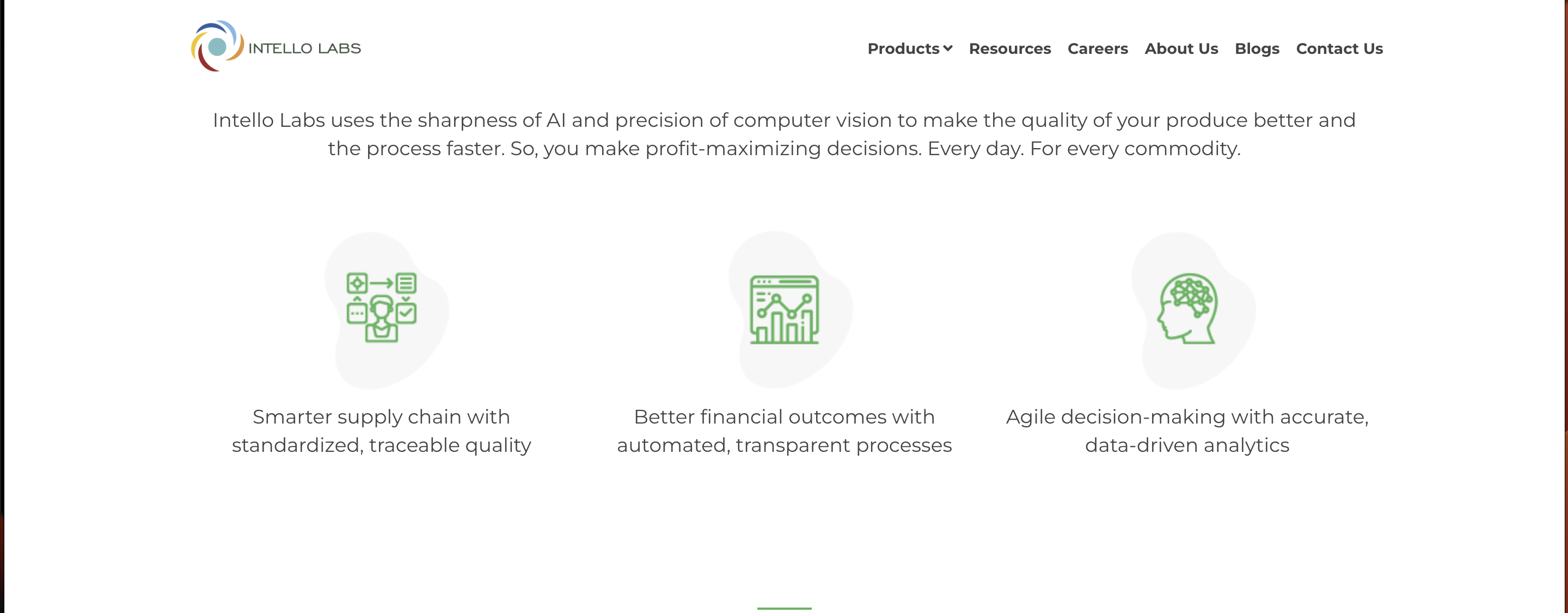
Intello Labs leverages AI, data science, and computer vision to enhance agricultural supply chains and help farmers achieve fair pricing. Its primary offering is an AI-driven quality grading system for fresh produce that uses smartphone cameras or machine-vision hardware to assess quality parameters like colour, size, bruising, and decay — eliminating subjectivity in post-harvest grading.
Top Features:
- Computer vision-based quality grading for fresh produce at the farmgate
- AI-powered shelf-life prediction for retailers and distributors
- Supply chain wastage analytics dashboard for agribusinesses
- Integration with procurement management systems
- Smartphone-compatible scanning for low-cost field deployment
Pros:
- Addresses India’s $13 billion annual post-harvest loss problem head-on
- Smartphone-first design removes hardware barriers and accelerates adoption
- Deployed across fresh produce, grains, and cotton supply chains
Cons:
- The accuracy of CV-based grading is still being refined for complex produce categories
- Business model relies on large agribusiness clients — slower sales cycles
- Limited brand recognition among farmer-facing audiences
Unnati (+ Gramophone)
HQ: Noida, Uttar Pradesh | Founded: 2016 (Unnati); 2016 (Gramophone) | Total Funding: ₹55 Cr+ (Gramophone) | Undisclosed (Unnati)
In January 2026, agritech startup Unnati acquired Gramophone — the Indore-based agri-input and advisory platform — in a stock-swap deal, with Info Edge transferring its 51% stake in Gramophone for a 15.7% stake in Unnati. This merger creates one of India’s more significant full-stack agritech plays, combining input distribution, digital advisory, and rural trade in Madhya Pradesh and Rajasthan. Gramophone had previously raised ₹55 crore in total funding from Info Edge, Asha Impact, and Better Capital. Post-merger, Unnati’s expanded platform serves farmers across agri-advisory, inputs, credit, and crop commerce through a single integrated platform.
Top Features:
- Integrated digital advisory and agri-input marketplace (post-merger)
- Personalised crop advisory in Hindi and Marathi for Central Indian farmers
- B2B rural trade platform for agri-commodity distribution
- Embedded agri-credit for retailers and farmers
- Farm management tools for crop cycle tracking and yield analysis
Pros:
- Strategic consolidation via acquisition creates a larger network and a combined farmer base
- Strong foothold in Madhya Pradesh and Rajasthan — high-potential, underserved agri markets
- Info Edge backing brings credibility and capital stability
Cons:
- Post-acquisition integration carries execution risks in product, people, and operations
- Brand consolidation between Gramophone and Unnati is still underway
- No large external funding round post-merger announced yet
FarmERP
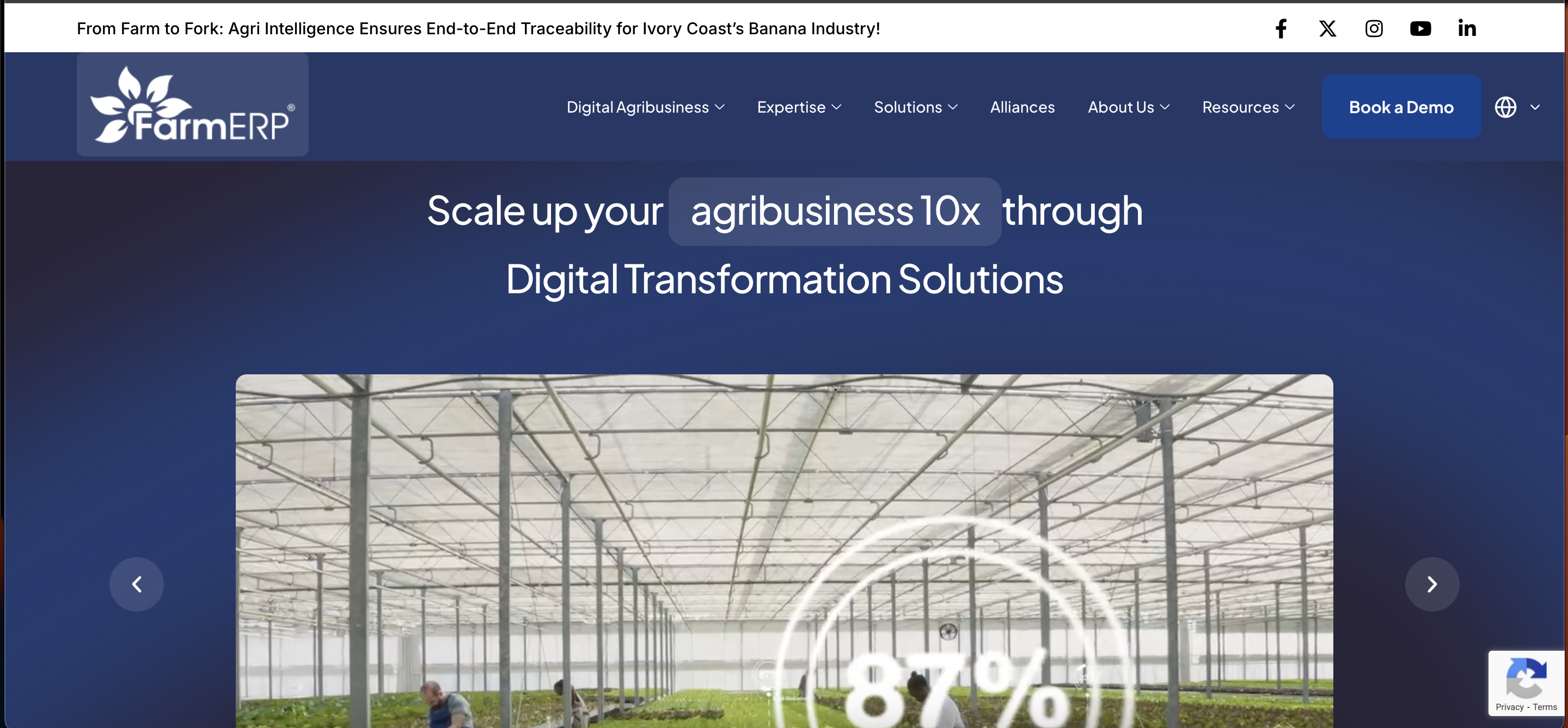
HQ: Pune, Maharashtra | Founded: 2015 | Total Funding: Undisclosed
FarmERP (by Shivrai Technologies) is one of India’s most widely deployed farm management software platforms, used by agribusinesses, food companies, processors, and exporters across 44 countries. It provides end-to-end farm digitisation — from crop planning and resource management to compliance tracking and traceability. FarmERP is widely used by export-oriented agribusinesses to achieve food safety certifications like GLOBALG.A.P. and HACCP, making it a trusted tool in India’s agri-export ecosystem.
Top Features:
- End-to-end crop lifecycle management: planning, operations, harvest, and post-harvest
- Compliance and traceability modules for food safety certifications (GLOBALG.A.P., HACCP)
- Satellite and drone imagery integration for remote farm monitoring
- IoT sensor integration for soil and weather monitoring
- Deployed across 44 countries; multilingual interface
Pros:
- Only India-origin farm management SaaS with genuine global reach across 44 countries
- Critical tool for agri-export compliance, a growing requirement post-FSSAI and global food safety regulations
- Highly customisable for horticulture, grains, spices, and plantation crops
Cons:
- SaaS pricing can be steep for small FPOs and cooperatives
- Not designed primarily for smallholder farmers, more suited to agribusinesses
- Funding details are not publicly disclosed, making competitive benchmarking harder
EM3 Agriservices
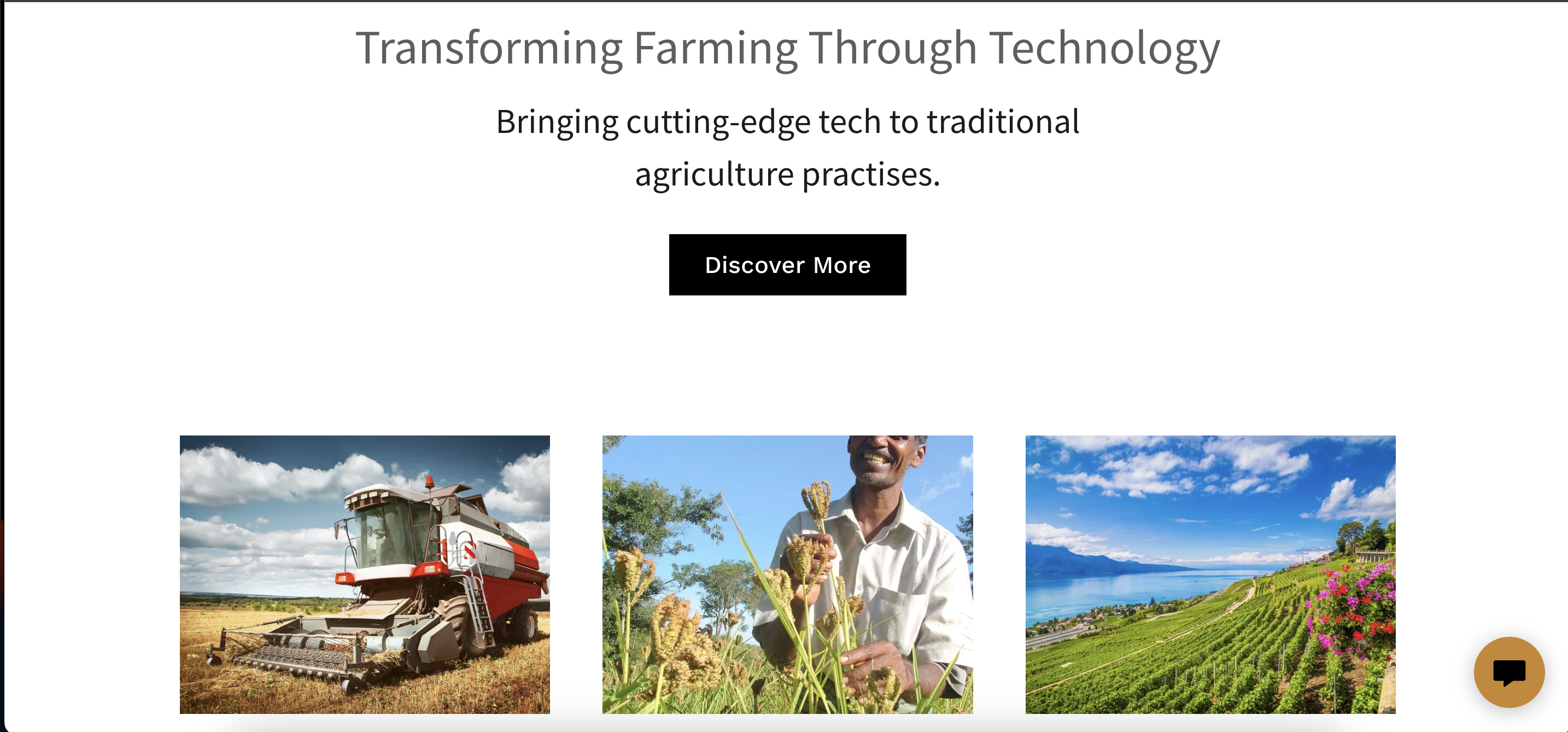
HQ: New Delhi | Founded: 2013 | Total Funding: $10M+ (Series B)
EM3 Agriservices operates on the “Uber of farm equipment” model — enabling smallholder farmers to access tractors, harvesters, laser land levellers, and other precision machinery on a pay-per-use basis through its Farming-as-a-Service (FaaS) platform, Samadhan. Given that over 85% of Indian farmers own less than 2 hectares, owning mechanised equipment is financially out of reach — EM3 solves this by formalising equipment sharing through a tech-enabled service layer. Today, EM3 serves over 250,000 acres of farmland across India through a network of Samadhan Kendras staffed by trained agri-professionals.
Top Features:
- Samadhan FaaS platform for on-demand farm mechanisation booking
- Coverage across the full crop cycle: land preparation, sowing, crop management, harvesting, and post-harvest
- Asset-light model: onboards local equipment owners rather than owning fleet outright
- IT-enabled Samadhan Kendras with trained agri-operators
- Transparent per-acre/per-hour billing to eliminate exploitation by informal operators
Pros:
- Democratises access to expensive farm machinery for marginal farmers at low cost
- The asset-light model makes the platform highly scalable across geographies
- Backed by the Global Innovation Fund for social impact potential
Cons:
- Scaling a physically distributed service network requires strong on-ground coordination
- Revenue per transaction is modest, requiring high volume for financial sustainability
- Limited digital-first penetration; model relies on physical Samadhan Kendras
AGRIM

HQ: Gurugram, Haryana | Founded: 2020 | Total Funding: $29M+
AGRIM is a B2B agri-input marketplace that directly connects rural agri-input retailers with manufacturers, cutting out layers of intermediary distributors. Founded by Mukul Garg and Avi Jain, the platform carries over 30,000 SKUs spanning seeds, pesticides, fertilisers, and farm equipment, and serves 25,000+ retailers who in turn reach 15 million farmers. In August 2024, AGRIM raised $17.3 million in a Series B round led by Asia Impact SA, with participation from Kalaari Capital, Omnivore, and Accion Venture Lab. It plans to expand its catalogue to 150,000 items and scale to southern and western India.
Top Features:
- B2B digital marketplace for 30,000+ agri-input SKUs (seeds, pesticides, fertilisers)
- Direct manufacturer-to-retailer model, eliminating multi-layer distribution markups
- Embedded working capital credit for agri-input retailers
- Logistics management for last-mile delivery to rural retailers
- Expanding to southern and western India with $17.3M Series B capital.
Pros:
- Solves a structural problem in India’s $50 billion agri-input distribution industry
- 25,000 retailer partners serving 15 million farmers — exceptional distribution depth
- Strong investor backing from Omnivore, Kalaari, and Accion Venture Lab
Cons:
- B2B marketplace model is operationally intensive with complex logistics requirements
- Currently concentrated in North and Central India, South and West expansion is in early stages
- Competition from DeHaat and AgroStar, who also operate integrated input platforms
BigHaat
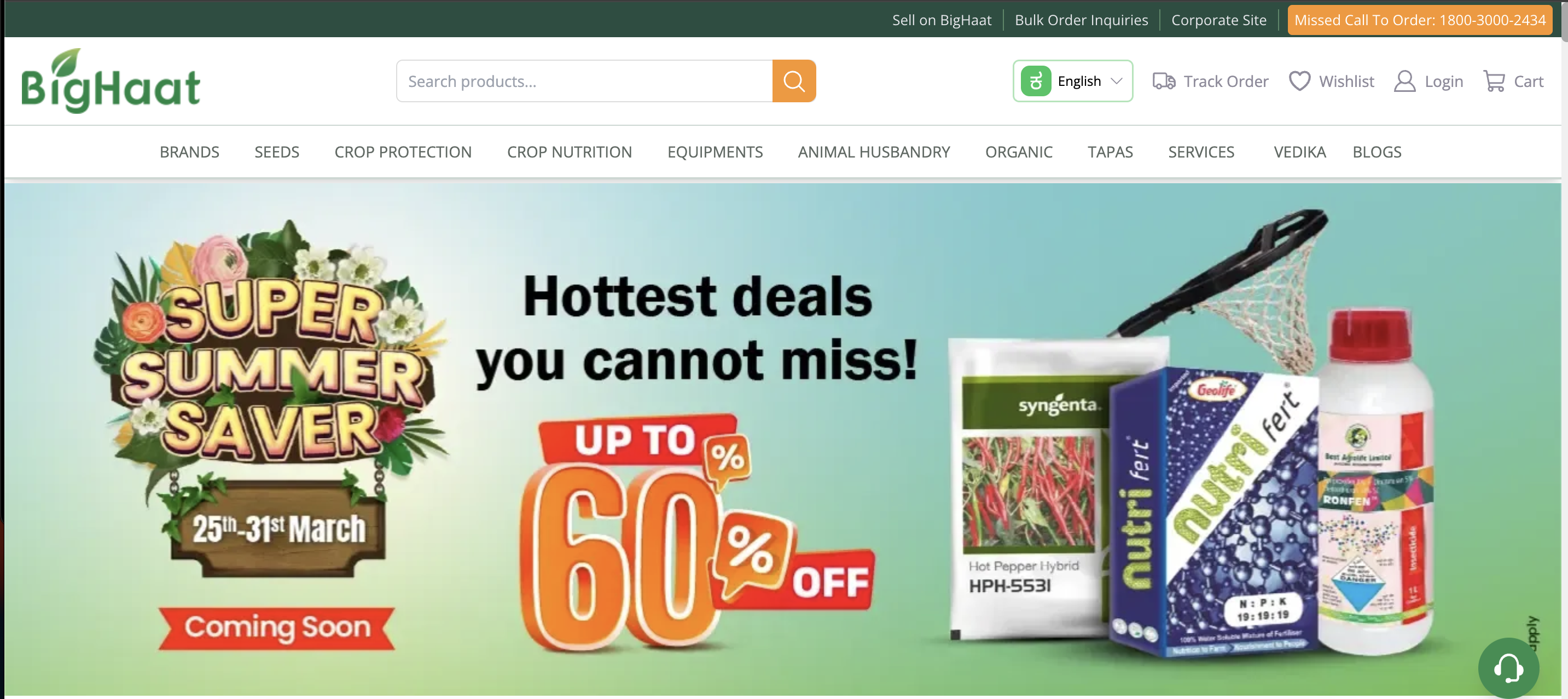
HQ: Bengaluru, Karnataka | Founded: 2015 | Total Funding: $30M+
BigHaat is one of India’s largest agri-input e-commerce platforms, offering over 50,000 agri-products across seeds, crop nutrition, crop protection, and farm equipment to farmers across 28 Indian states. Founded by Sateesh Nukala and Sachin Nandwana, BigHaat blends digital commerce with agronomic advisory — farmers can purchase inputs online while simultaneously accessing expert guidance. It supports over 14 regional languages and has built a strong community-based extension model through partnerships with KVKs and agriculture universities.
Top Features:
- 50,000+ SKUs across all agri-input categories on a single platform
- Multilingual support across 14 Indian languages
- Advisory-linked commerce: expert recommendations drive input purchases
- BigHaat Saathi — a community extension model for last-mile advisory delivery
- Direct-to-farmer logistics with pan-India reach across 28 states
Pros:
- One of the widest agri-input catalogues in India with 50,000+ SKUs.
- Multilingual, inclusive platform design accelerates farmer adoption in non-Hindi regions
- Backed by Faida Capital, Oman India Joint Investment Fund, and others
Cons:
- Heavy competition from AgroStar, DeHaat, and AGRIM in digital agri-input commerce
- E-commerce-led model faces logistics cost pressures in remote rural geographies
- Profitability trajectory not publicly disclosed
KhetiGaadi
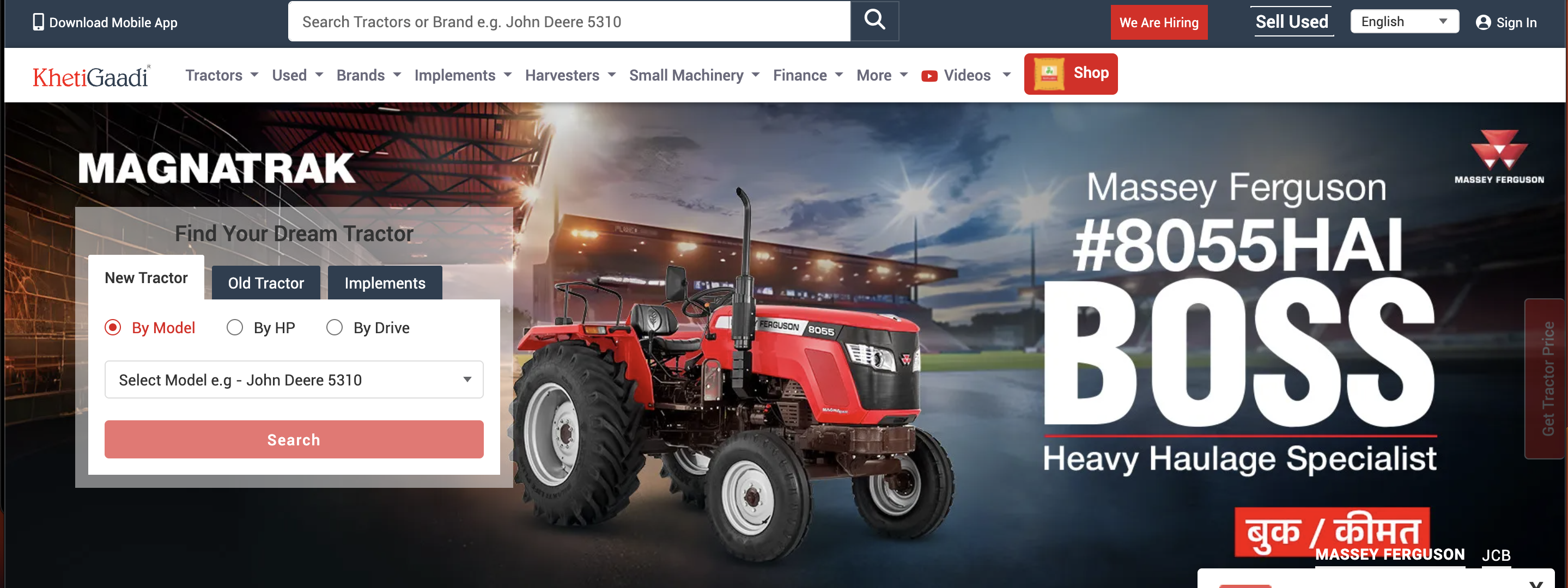
HQ: Pune, Maharashtra | Founded: 2016 | Total Funding: Undisclosed
KhetiGaadi is India’s first and largest online marketplace for buying, selling, and renting agricultural machinery. The platform connects farmers with tractor dealers, equipment OEMs, and individual equipment owners across India, making farm mechanisation accessible and affordable. With 5 million+ farmers on its app and a GMV that grew from ₹50 crore in 2020 to ₹1,500 crore in FY22, KhetiGaadi is one of the most adopted agri-mechanisation platforms in India.
Top Features:
- India’s largest online marketplace for buying, selling, and renting agricultural machinery
- KhetiGuru: advisory and soil micronutrition guidance platform for crop management
- 5 million+ farmer users on the app
- Equipment listings from OEMs, dealers, and individual tractor owners
- Soil nutrition supplements and a natural agri-product line
Pros:
- 5 million+ farmers on the app — massive distribution reach
- GMV growth from ₹50 crore to ₹1,500 crore in two years demonstrates strong product-market fit
- First-mover advantage in the under-penetrated agri-machinery rental and resale market
Cons:
- Funding details are not publicly disclosed, making competitive benchmarking difficult
- Machinery resale and rental is a high-touch, trust-dependent business that is hard to scale digitally
- Launch of KhetiGuru advisory faces intense competition from established agri-advisory platforms
Stellapps
HQ: Bengaluru, Karnataka | Founded: 2011 | Total Funding: $57M+ (incl. $26M Series C)
Stellapps is India’s leading dairy technology company, digitising the entire milk supply chain from farm to chilling centre to dairy processor using IoT, AI, and data analytics. Incubated at IIT Madras, it works with India’s largest dairy operators — Amul, Mother Dairy, and Heritage Foods — and has deployed its technology across 42,000 villages, facilitating the movement of over 14 million litres of milk daily. In October 2024, it raised $26 million in a Series C round backed by Blume Ventures, Omnivore, and the Bill & Melinda Gates Foundation.
Top Features:
- IoT-based milk quality testing and real-time monitoring at village chilling centres
- mooOn: cow health and productivity monitoring using smart tags
- mooMark: contract dairy manufacturing for value-added dairy products (VADP)
- Traceability from individual cow to the end consumer
- Integration with India’s largest dairy co-operatives (Amul, Mother Dairy)
Pros:
- Deployed at unprecedented scale — 42,000 villages, 14M litres of milk/day
- Backed by marquee investors, including the Bill & Melinda Gates Foundation
- mooMark VADP business adds a high-margin revenue stream beyond SaaS
Cons:
- Dairy-specific focus limits diversification into broader agritech opportunities
- Scaling IoT hardware across 42,000+ villages requires ongoing maintenance investment
- Dependency on large dairy co-operative partners for distribution creates customer concentration risk
Syngenta Digital (Cropwise)
HQ: Basel, Switzerland (India Operations: Mumbai) | Founded: 1999 (Cropwise platform: 2019) | Total Funding: Part of Syngenta Group
Syngenta’s Cropwise platform is the global agritech giant’s answer to the precision farming revolution, and it has a meaningful India presence given Syngenta’s large agrochemical and seeds business across the subcontinent. Cropwise brings together satellite imagery, agronomist advisory, field scouting, crop planning, and sustainability tracking into a single digital platform used by agribusinesses, input companies, and large farms globally.
Top Features:
- Cropwise Sustainability: carbon footprint tracking and climate-smart agronomy
- Cropwise Grower: personalised crop advisory with satellite imagery and weather integration
- Field scouting tools for pest, disease, and weed detection
- Agronomist and agribusiness dashboards for portfolio-level farm management
- API integrations for agribusinesses to embed Cropwise intelligence into their workflows
Pros:
- Backed by one of the world’s largest agribusinesses — near-limitless R&D resources
- Cropwise’s API-first architecture makes it highly integrable for agribusinesses
- Strong sustainability credentials are increasingly important for ESG-aligned investors and regulators
Cons:
- As a global multinational, its India-specific product localisation is limited compared to Indian-born startups
- Designed for large commercial farmers and agribusinesses — less relevant for Indian smallholders
- Commercial interests of parent company Syngenta (seeds and chemicals) may create perception conflicts in advisory
What’s Powering India’s AgriTech Boom?
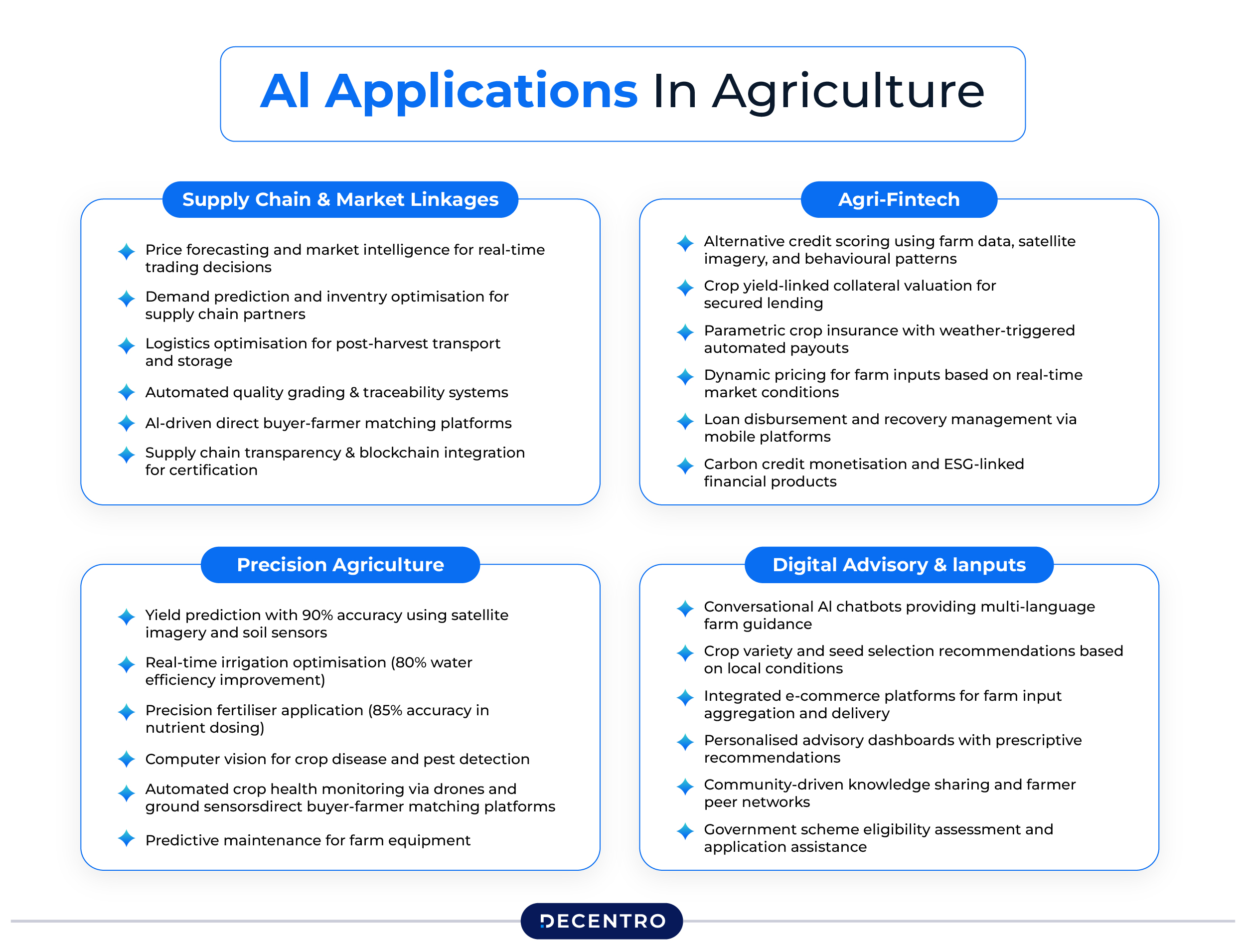
The top agritech startups in India aren’t just building apps — they’re rebuilding the entire agricultural infrastructure of a $500 billion industry. A few macro themes underpin this explosion:
- Agri-fintech convergence: Platforms like Bijak, AGRIM, and Arya.ag are embedding credit, insurance, and warehouse receipt financing directly into agri-commerce flows, giving farmers financial access they never had before.
- Post-harvest tech: With India losing an estimated ₹90,000 crore annually in post-harvest losses, startups like Intello Labs, Arya.ag, and AgNext are finally making quality, storage, and traceability economically viable at scale.
- Climate-smart agriculture: The $30M raise by AgroStar from Just Climate and Arya.ag’s ₹725 crore Series D from GEF Capital are clear signals — climate resilience is the next frontier for agritech investment.
- Government push: Schemes like PM Kisan, Digital Agriculture Mission, and NABARD’s agritech fund are creating structural tailwinds for digital adoption at scale.
How Decentro Powers AgriTech Fintech
The common thread running through every top agritech startup in India? They all need financial infrastructure, and they need it embedded seamlessly into their user experience.
Whether it’s DeHaat disbursing agri-credit to a farmer in Bihar, AGRIM offering working capital to a rural input retailer in Rajasthan, Arya.ag issuing Warehouse Receipt Financing against stored grain, or Bijak facilitating B2B trade credit across commodity markets, every agritech platform eventually becomes a fintech platform. And that’s where Decentro comes in.
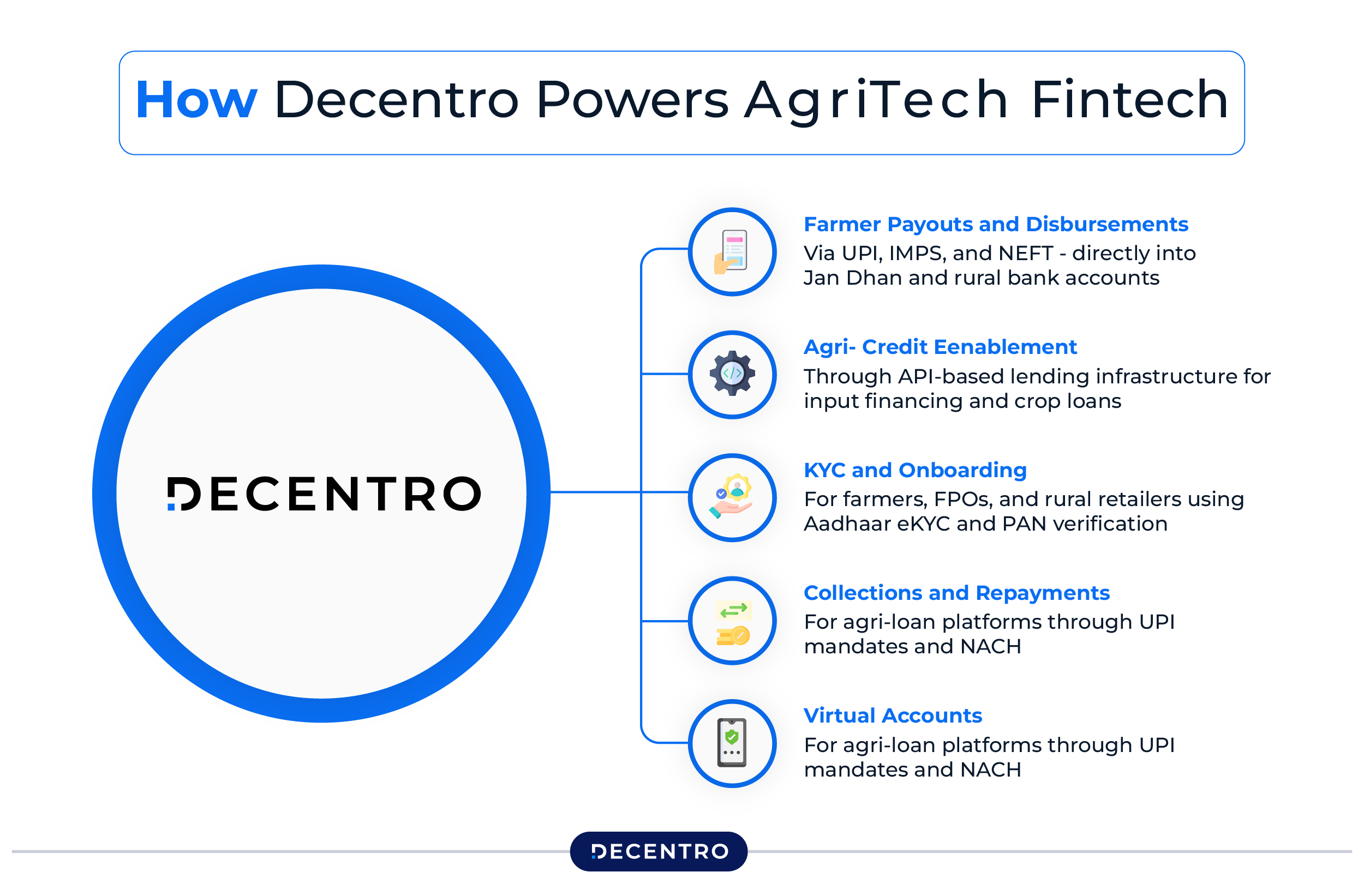
Decentro is India’s leading full-stack financial API infrastructure platform, purpose-built for businesses that need to embed payments, lending, banking, KYC, and collections into their products, fast, reliably, and at scale. For agritech companies, Decentro powers:
- Farmer payouts and disbursements via UPI, IMPS, and NEFT — directly into Jan Dhan and rural bank accounts
- Agri-credit enablement through API-based lending infrastructure for input financing and crop loans
- KYC and onboarding for farmers, FPOs, and rural retailers using Aadhaar eKYC and PAN verification
- Collections and repayments for agri-loan platforms through UPI mandates and NACH
- Virtual accounts for agri-commodity platforms to reconcile high-volume trader payments in real time
If you’re building the next great agritech platform in India and need payments, lending, or banking APIs that work reliably at scale, we are here for you.
Frequently Asked Questions
1. What is the current size of the AgriTech market in India?
India’s agritech market was valued at approximately $974 million in 2025 and is projected to reach $2.52 billion by 2034, growing at a CAGR of 10.59%.
2. Which is India’s most funded AgriTech startup?
Ninjacart leads with $407M+ in total funding, followed by DeHaat at $270M+ and WayCool Foods [now shut] at $280M+.
3. What are the key focus areas of AgriTech startups in India?
India’s leading agritech startups operate across precision farming, B2B supply chain, agri-input e-commerce, post-harvest storage, AI-based quality assessment, farm mechanisation, dairy tech, and embedded agri-fintech.