Learn how credit line on UPI works, who can offer it, how to activate it, and what banks and fintechs need to launch one under 2026 RBI rules.
Credit Line on UPI: Meaning, How It Works, Banks & RBI Rules (2026)

A true blue millennial trying to engineer her full time-career around the world of content. How cliché is that?
Table of Contents

Credit line on UPI at a glance
A credit line on UPI lets you pay merchants from any UPI app using a pre-approved credit limit from your bank, instead of the balance in your savings account. UPI already moves about 800 million payments a day. Credit is the next layer being added to those rails.
- What it is: a pre-sanctioned credit line from a bank, linked to your UPI ID and used like any other funding source.
- What it works for today: payments to merchants (P2M) through QR codes and online checkouts. NPCI’s 2025 update reportedly extends use to P2P, small-merchant payments and cash withdrawals, but only where the issuing bank’s terms allow it.
- Who regulates it: the RBI opened the door in September 2023, and NPCI added purpose-based usage rules that took effect on 31 August 2025.
- Why it matters: it can take credit to people who have never held a credit card, using a payment habit they already have.
- Who has to build it: banks, fintechs and UPI apps, each needing onboarding, underwriting, credit line management and repayment systems that talk to the UPI switch.
What is a credit line on UPI?
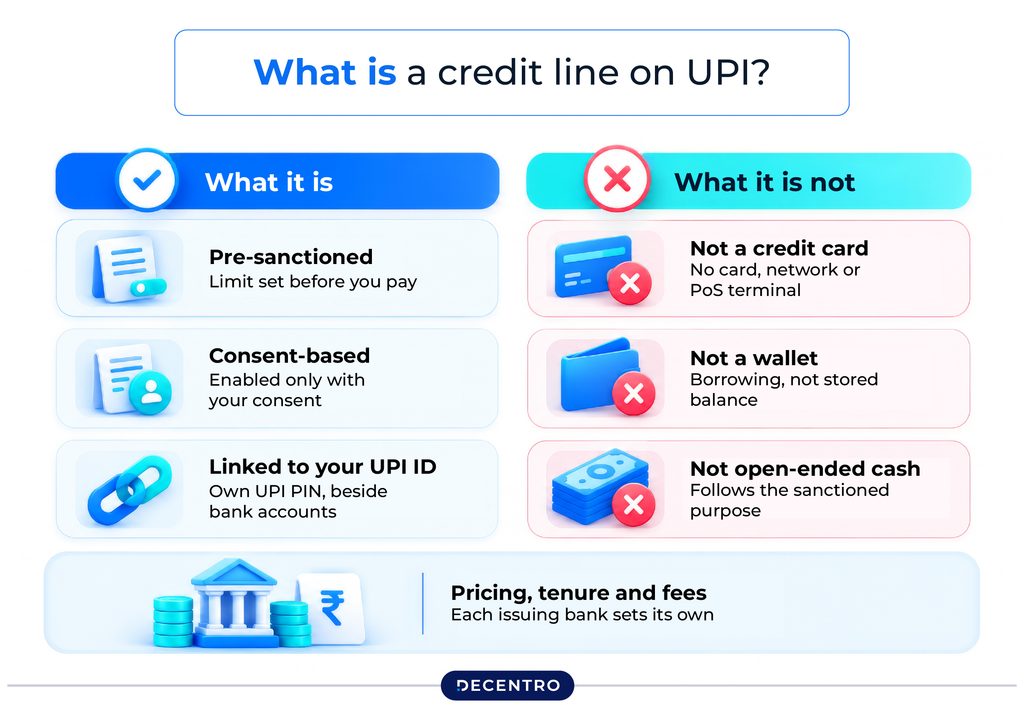
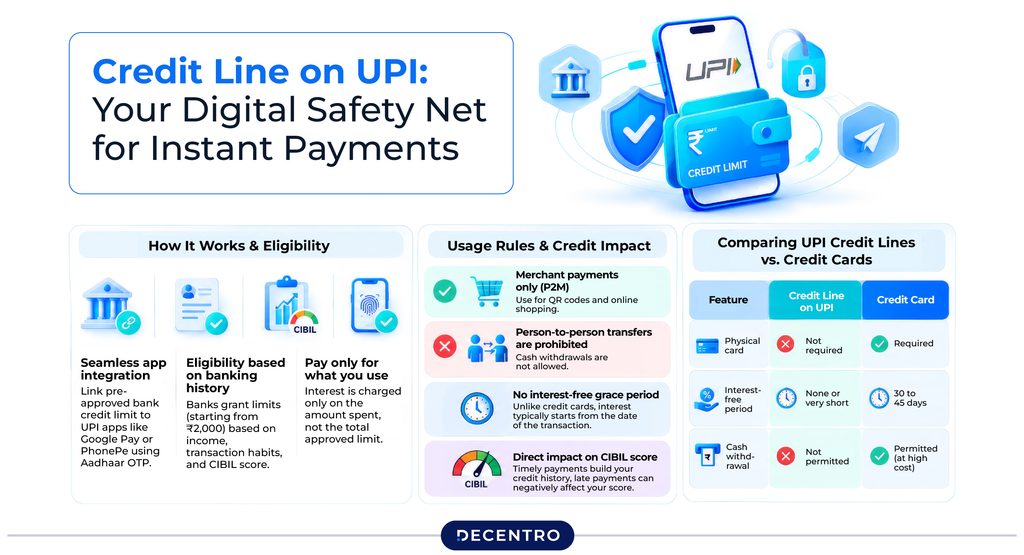
A credit line on UPI is a loan limit that a bank sanctions in advance and makes available as a payment option inside UPI apps. When you pay a merchant, the amount is drawn from that limit. Your savings account is not debited, and you repay the bank later.
Three things define it:
- Pre-sanctioned. The bank assesses you and sets the limit before you pay, so there is no credit check at checkout.
- Consent-based. The credit line is enabled for UPI only with your prior consent.
- Linked to your UPI ID. Once linked, it shows up beside your bank accounts as a funding source. It has its own UPI PIN, separate from the one for your savings account.
What it is not
- Not a credit card. There is no physical card, card network or PoS terminal involved. RuPay credit cards on UPI are a different, older product.
- Not a wallet. You are borrowing from a bank limit, not spending stored balance.
- Not open-ended cash. Usage is meant to follow the purpose the credit line was sanctioned for.
Each issuing bank sets pricing, tenure and fees, so they vary from one credit line to another.
How does a credit line on UPI work?
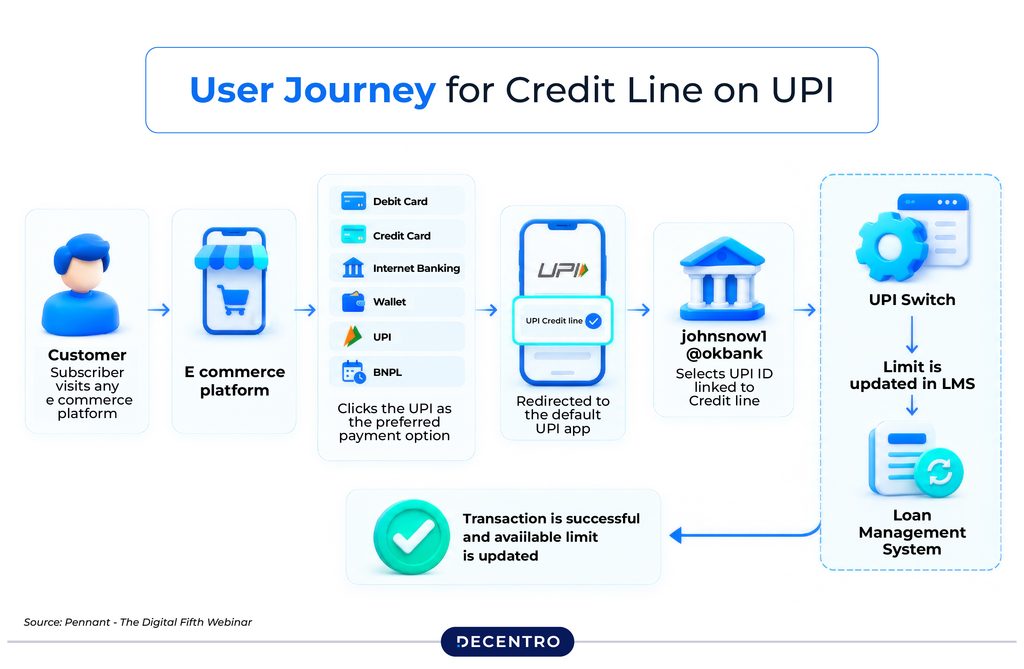
The flow has five steps, and the first one happens before you open a UPI app.
- The bank sanctions a limit. The issuing bank assesses you and approves a credit line. NPCI notes that banks can use data analytics to spot customers for small-ticket credit lines, then raise limits as repayment patterns build.
- You link it to a UPI app. The app finds credit lines held under your registered mobile number at the issuing bank. You pick one and set a separate UPI PIN for it.
- You pay with it. At a QR scan or an online checkout, you choose the credit line instead of your savings account. Standard UPI transaction limits apply, and the issuer approves or declines each payment against its terms.
- The balance updates. The available limit drops by the amount spent. The app shows the used limit and any EMI details.
- You repay the bank. You can pay to the credit line’s UPI ID or set up a UPI AutoPay mandate. Late repayment can hurt your credit score.
Three systems take part in every payment: the UPI app, the UPI switch run by NPCI, and the bank’s lending system. The lending system stays the system of record. It holds the limit, the balance, the bill and the repayment status, which is why banks have had to change their own systems to support the product.
Credit line on UPI vs credit card on UPI
A credit line on UPI sits between paying from a savings account and paying with a credit card. The main difference from a card is that the credit comes from a loan account, not a card network.
| Option | Money comes from | Card needed? | Who issues it | Repayment |
| UPI from a savings account | Your own bank balance | No | Your bank | None, the money leaves your account instantly |
| RuPay credit card on UPI | Your credit card limit | Yes, a RuPay credit card | The card issuer | The card bill, on the card’s billing cycle |
| Credit line on UPI | A limit sanctioned by your bank | No | Scheduled commercial banks, and small finance banks since February 2025 | The bank’s loan account, by UPI payment to the credit line’s ID or AutoPay |
Because a credit line is a loan, its limit, tenure, interest and fees follow the sanction terms. They differ from one bank to the next.
How credit on UPI got here
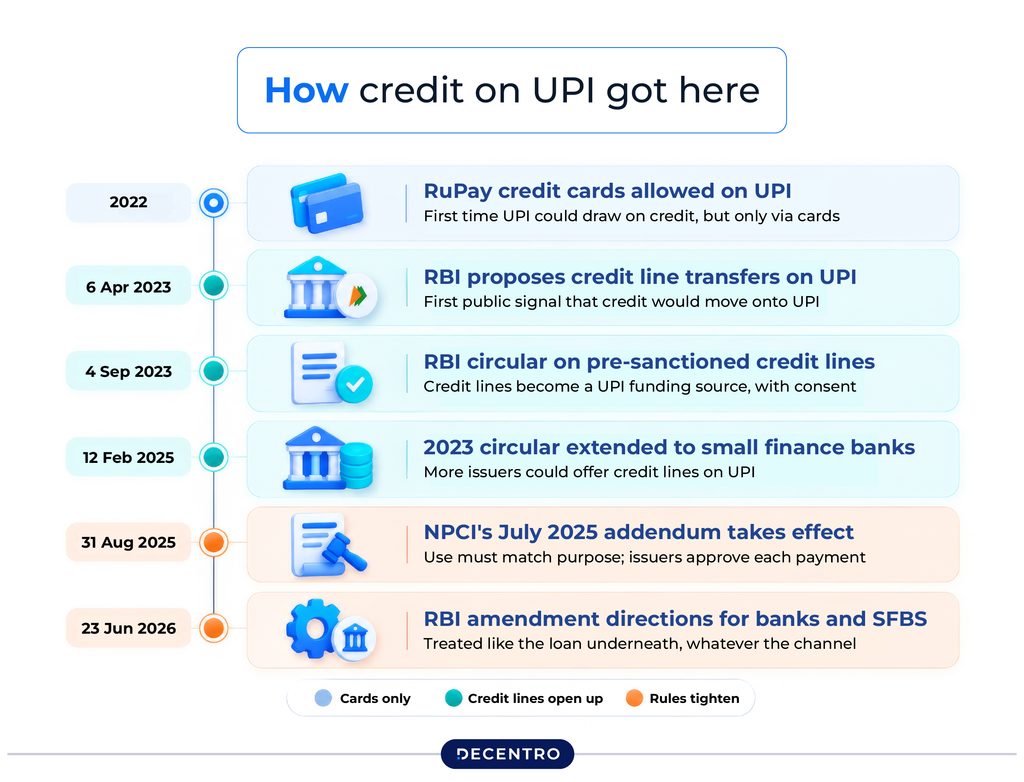
Credit reached UPI in steps over four years, and the rulebook is still being tightened. The latest RBI directions came in June 2026.
| Date | What happened | Why it matters |
| 23 Jun 2026 | RBI issued amendment directions for commercial banks and small finance banks | A UPI credit line is treated for prudential purposes like the loan underneath it, whatever the channel |
| 31 Aug 2025 | NPCI’s July 2025 addendum took effect | Use must match the sanctioned purpose, and issuers approve or decline each payment |
| 12 Feb 2025 | The 2023 circular was made applicable to small finance banks | More issuers could offer credit lines on UPI |
| 4 Sep 2023 | RBI circular on pre-sanctioned credit lines at banks through UPI | Credit lines became a funding source on UPI, with customer consent |
| 6 Apr 2023 | RBI proposed enabling transfers to and from pre-sanctioned credit lines, as reported by Unit Economics | The first public signal that credit would move onto UPI |
| 2022 | RuPay credit cards were allowed on UPI, as noted by Outlook Money | UPI could draw on credit for the first time, but only through cards |
Rules and limits to know
Credit lines on UPI are regulated as bank loans, so the rules come from both the RBI and NPCI. Six points cover most of what a newcomer needs.
- Banks issue them. Scheduled commercial banks were first, followed by small finance banks in February 2025. Industry commentary from mid-2026 says NBFCs cannot yet issue credit lines directly on UPI, and the NBFC industry body FIDC has asked the RBI to consider it. Check the latest RBI position before relying on this.
- Many loan types can qualify. NPCI’s 2025 update, as reported by Upstox, covers credit against fixed deposits, shares and bonds, gold and property, plus personal, business, unsecured and Kisan Credit Card lines.
- Use follows purpose. An interest-bearing credit line used on UPI should match the loan’s sanctioned purpose. The issuer can decline a payment that does not.
- Standard UPI limits apply. NPCI says normal UPI transaction limits apply to credit line payments, and a bank may set tighter ones.
- It has its own PIN. NPCI advises a UPI PIN for the credit line that differs from your savings account PIN.
- Disputes go through UPIHelp. The grievance channel in UPI apps covers credit line payments, according to NPCI.
The RBI’s June 2026 directions add one more rule for banks: the terms of any credit facility tied to a specific payment mode must be part of the bank’s credit policy, and only facilities a bank may already sanction can be offered this way.
How to activate a credit line on UPI
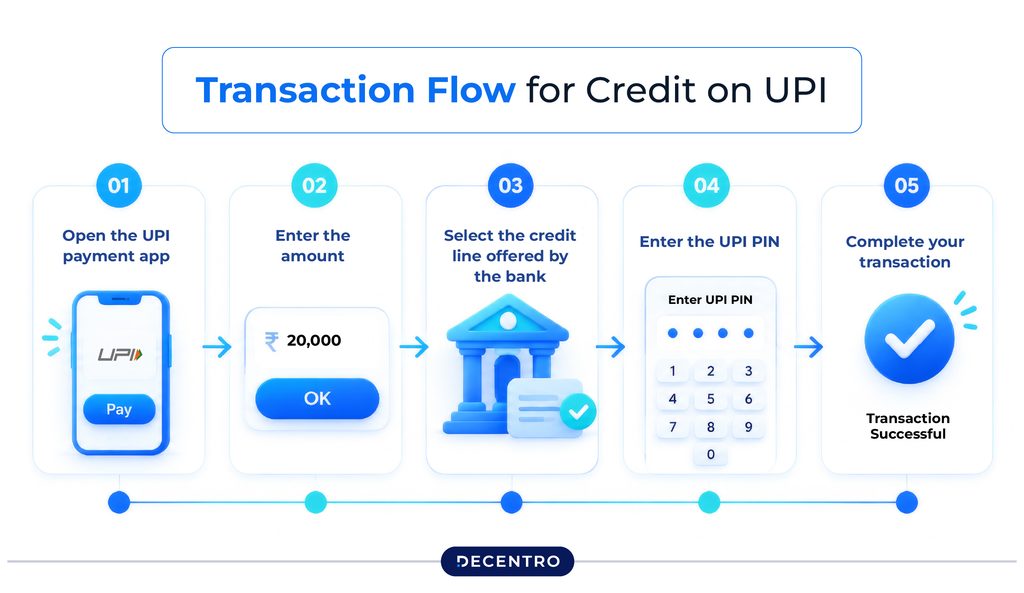
You cannot apply for a credit line from scratch inside a UPI app. Your bank has to offer you one first, and activation then takes a few minutes.
Step by step
- Look for an offer. Check your bank’s app or a UPI app banner for a credit line offer.
- Match your mobile number. The bank and the UPI app must use the same registered number.
- Add the credit line. In your UPI app’s payment methods, choose “Add credit line” and select your bank.
- Verify and set a PIN. Confirm with an OTP, accept the terms and set a separate UPI PIN for the credit line.
In each app
Google Pay.
Tap your profile picture, then Set up payment methods, then Add credit line. Verify with an Aadhaar OTP or a bank OTP and follow the on-screen steps. Google’s help page says credit lines work for merchant payments only and cannot receive money.
PhonePe.
Open the profile section and select the bank that gave you the credit line. Follow the prompts and set a UPI PIN, and the line appears as a payment option. Some banks also show an activation banner for pre-approved customers.
Paytm.
Banks describe the same flow for any UPI app, Paytm included: choose “Add a credit line”, select your bank, verify with an Aadhaar OTP and set a UPI PIN. Menu names change between app versions, so the Hindi walkthrough above is a handy visual reference.
Eligibility
- Completed KYC. Your bank needs your KYC on file, typically Aadhaar and PAN. Higher limits may need income proof.
- An account with a participating bank. Only banks that offer credit lines on UPI can sanction one, and it must be pre-approved for you.
- Credit history. Banks assess your credit score, income and repayment record. NPCI says they may also use UPI payment behaviour to set small starting limits.
Benefits and challenges
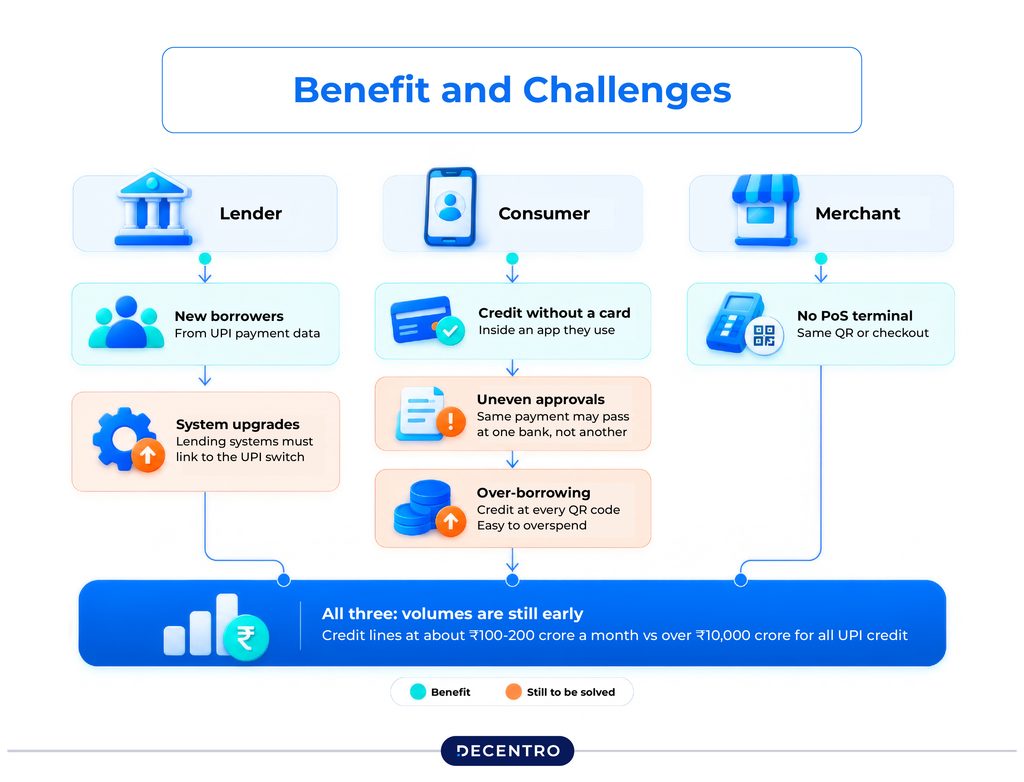
Credit on UPI helps three groups, and each gain comes with a practical catch.
Who benefits
- Consumers get credit inside an app they already use, with no physical card. NPCI describes the aim as small-ticket, high-volume retail loans that widen financial inclusion.
- Merchants can accept credit through the UPI QR code or checkout they already have, without a PoS terminal. PhonePe has argued that this lowers cart abandonment, as reported by Crowdfund Insider.
- Lenders can use UPI payment data to find customers for small credit lines. They can start low and raise limits as repayment history builds, as NPCI’s product overview describes.
What still has to be solved
- Volumes are early. One lender-side analysis from around NPCI’s 2025 guidelines put credit line volumes at roughly ₹100 to 200 crore a month, against more than ₹10,000 crore a month for all credit on UPI. Source: ScoreMe.
- Banks must change their own systems. Showing the available limit or generating a bill after each cycle needs lending systems that talk to the UPI switch, as Unit Economics explains. Smaller players without that integration find it hard to launch.
- Rules vary by issuer. Purpose-based approval means the same payment can pass at one bank and fail at another, which confuses people with loans at several banks.
- Easy credit can become over-borrowing. A payment option at every QR code makes it simple to spend beyond a repayment plan.
What it takes to launch a credit line on UPI
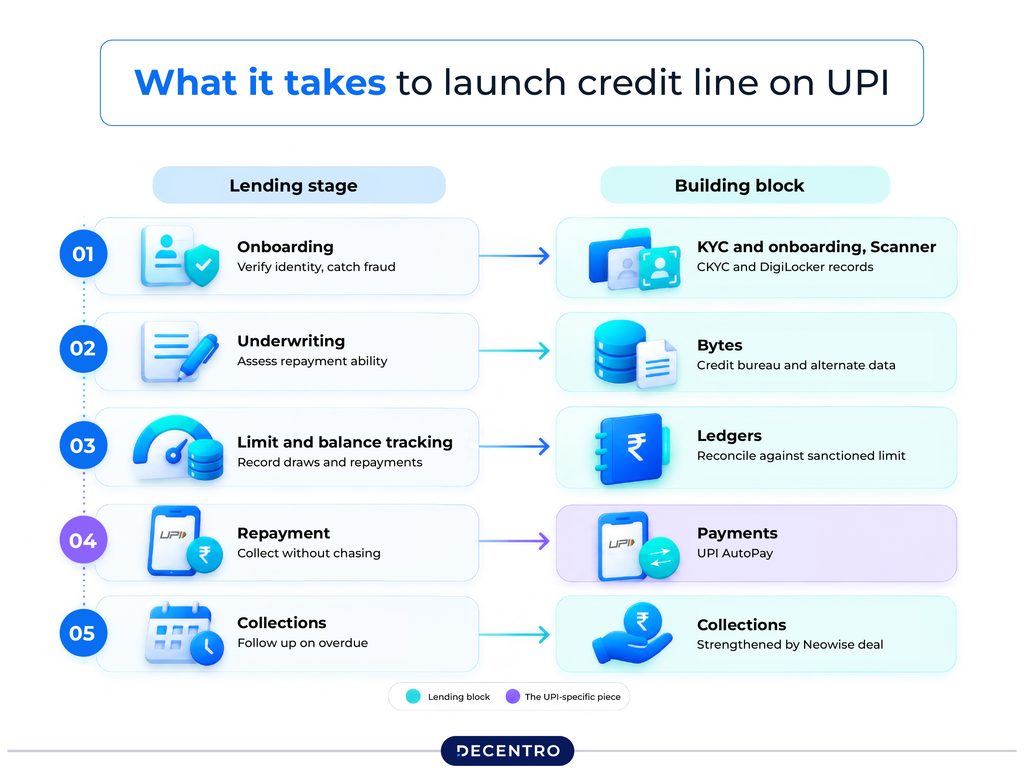
Launching a credit line on UPI is a lending build first, and a payments build second. The UPI part is a funding source. Everything around it is a loan: onboarding, underwriting, limit management, repayment and collections.
This is why a credit line on UPI is an emerging use case for embedded finance stacks such as Decentro’s Fabric. Decentro launched Fabric in 2023 as a banking-as-a-service stack for onboarding users to financial products, card issuance and lending. A UPI credit line draws on the same building blocks.
| Stage | What the team has to do | Building block it maps to |
| Onboarding | Verify identity, pull CKYC and DigiLocker records, catch fraud early | KYC and onboarding, Scanner |
| Underwriting | Assess repayment ability, including for people with thin credit files | Credit bureau and alternate data under Bytes |
| Limit and balance tracking | Record every draw and repayment against the sanctioned limit and reconcile it | Ledgers |
| Repayment | Collect on the due date without chasing the customer | UPI AutoPay under Payments |
| Collections | Follow up on overdue accounts | Collections, strengthened by Decentro’s acquisition of Neowise |
The link to the UPI switch itself runs through the issuing bank, which is why the bank-fintech partnership model matters. Which blocks a team needs depends on its role. A bank issuing the line needs the full loan stack, while an app or fintech distributing it may need only onboarding and repayment.
Where credit on UPI is heading
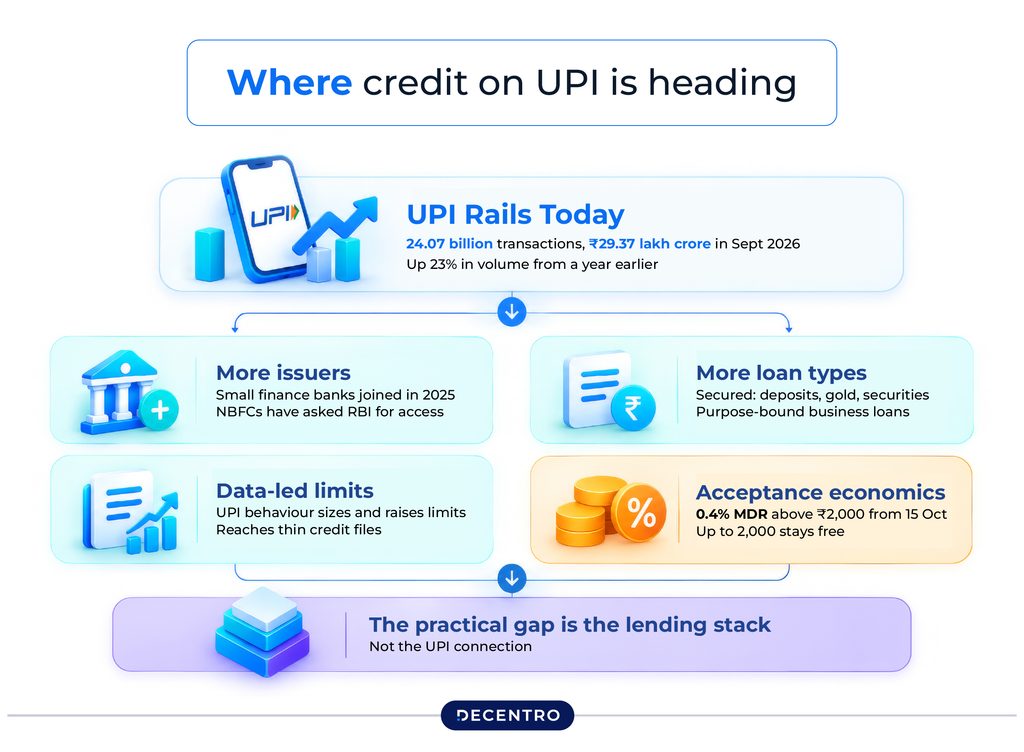
Credit line on UPI is still small, but it sits on rails that processed 24.07 billion transactions worth ₹29.37 lakh crore in September 2026, up 23% in volume from a year earlier (Outlook Money). Four things are worth watching.
- More issuers. Small finance banks joined in 2025, and the NBFC industry has asked the RBI to consider access for eligible NBFCs.
- More loan types on UPI. Secured lines against deposits, gold and securities, and purpose-bound business loans widen who can use the feature.
- Data-led limits. NPCI expects banks to use UPI payment behaviour to size and raise limits. Better data should let lenders reach people with thin credit files.
- Changing acceptance economics. From 15 October 2026, a 0.4% merchant discount rate applies to specified merchant payments above ₹2,000. Payments up to ₹2,000 stay free. How acceptance costs shape credit on UPI is one to follow.
For teams building in this space, the practical gap is rarely the UPI connection. It is the lending stack behind it.
Building credit on UPI with Decentro Fabric
If you are a bank, NBFC or fintech exploring a credit line on UPI, the build is mostly a lending stack: onboarding, underwriting data, ledgers, repayments and collections. Decentro Fabric brings these together through APIs. Explore the Decentro documentation or talk to the team about how a UPI credit line would fit your product.
Frequently Asked Questions
Is a credit line on UPI the same as a credit card on UPI?
No. A credit card on UPI draws on a card limit and needs a RuPay credit card. A credit line on UPI draws on a loan limit sanctioned by your bank and needs no card.
Do I need a credit card to use it?
No. You need a pre-sanctioned credit line from a participating bank, linked to a UPI app.
Is there interest on a UPI credit line?
It depends on the bank. The issuer sets pricing, tenure and any interest-free period under the terms of the credit line.
Can I send money to friends with it?
When the feature launched in 2023, it was for merchant payments only. NPCI’s 2025 update reportedly allows P2P transfers and cash withdrawals too, but only where your issuing bank permits them. Check your bank’s terms.
How do I repay?
You can pay to the credit line’s UPI ID or set up a UPI AutoPay mandate, according to NPCI. Repay on time, because late payment can affect your credit score.
Can I link more than one credit line to a UPI ID?
Reportedly yes. Each credit line is tied to a different bank, according to Fibe.
Which UPI apps support it?
NPCI says you can link a credit line on any UPI app, though availability depends on both your bank and the app.
Can NBFCs offer credit lines on UPI?
Not directly, according to mid-2026 industry commentary. Banks issue the lines today.
What happens if a payment is declined?
The issuing bank can decline a payment that does not fit the credit line’s terms or sanctioned purpose. You can raise disputes through UPIHelp in your UPI app.