EMI receipting is how lenders record each loan repayment and issue proof of payment. See how it works, what an EMI receipt must include, and the RBI rules.
EMI Receipting: Meaning, Process & What a Receipt Includes

A true blue millennial trying to engineer her full time-career around the world of content. How cliché is that?
Table of Contents

| Summary: EMI receipting is the process of recording, confirming, and issuing proof for every loan repayment a borrower makes. It sounds like back-office plumbing, but in India’s ₹3.25 lakh crore microfinance sector, it can be the difference between a borrower trusting a lender and walking away from formal credit altogether. This article covers what EMI receipting means, how a modern collection console works, why RBI’s 2022 and 2026 regulatory updates have made digital receipting essential, and where cross-border collection and borrower communication fit into the picture for lenders scaling beyond a single branch, region, or country. |
The market context: why this matters right now
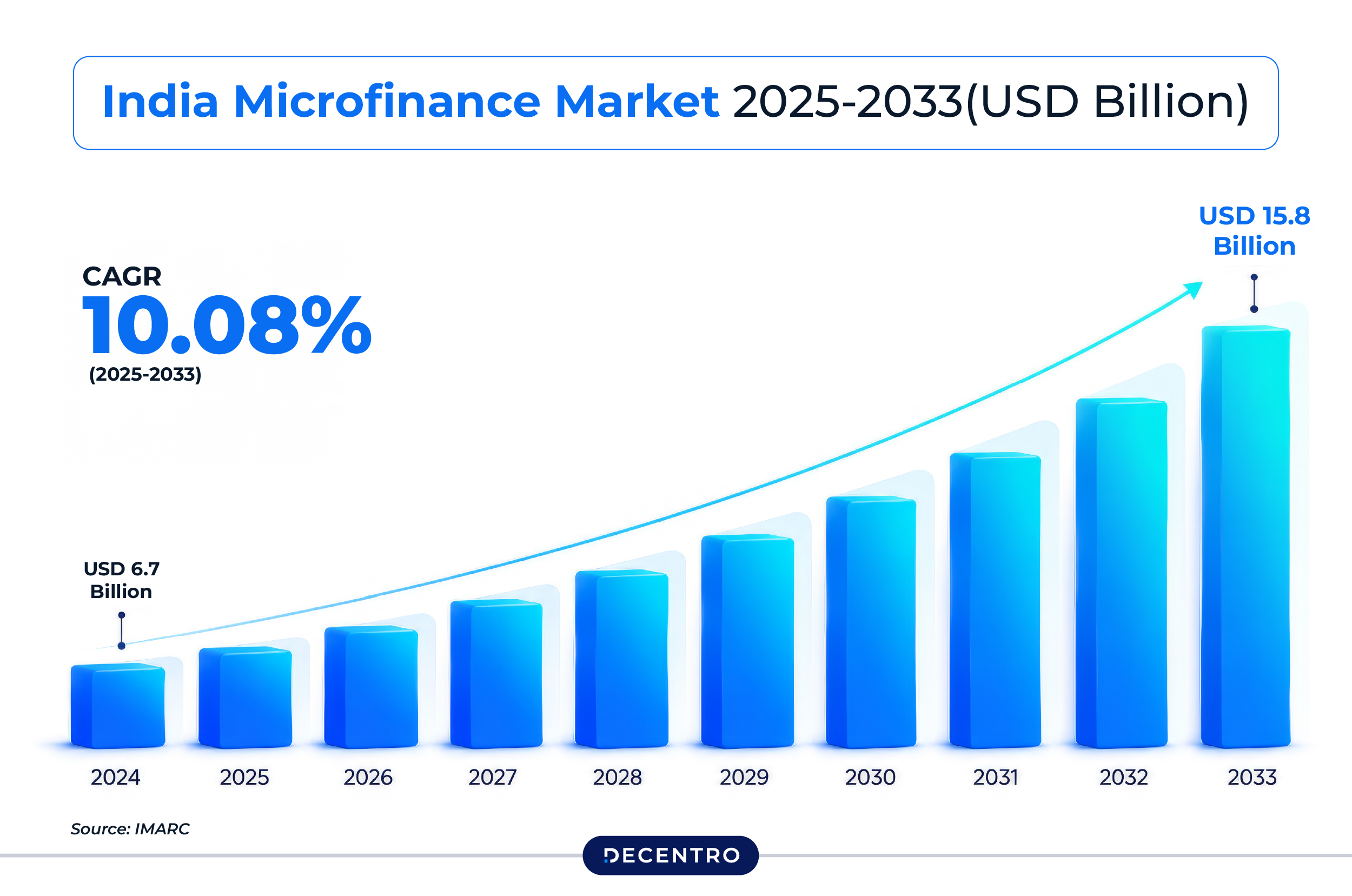
Microfinance in India is a lifeline for tens of millions of low-income households. As of March 2026, the sector’s total loan portfolio stood at roughly ₹3,25,174 crore, serving 10.1 crore active loan accounts across the country. That is over a hundred million loan relationships, each one requiring an EMI to be collected on time, recorded correctly, and receipted transparently.
The sector is also going through a rough patch. Microfinance lenders had a gross loan portfolio of ₹3.39 trillion in Q2 FY26, down 17% from the previous year and the sixth straight quarterly decline, with nearly 5 million borrowers exiting formal credit. Credit to the sector fell 9.3% in H1 FY26, with active borrowers shrinking by 78 lakh. Meanwhile, RBI’s Financial Stability Report noted that borrower indebtedness, measured by the share of borrowers with loans from three or more lenders, rose marginally in September 2025 after two years of decline.
In a shrinking, stress-tested market, precision matters more than ever. Lenders cannot afford collection leakage, disputed repayments, or borrowers who feel shortchanged. That is exactly where EMI receipting and the console technology behind it earn their keep.
What is EMI receipting
Strip away the jargon and EMI receipting is simple. Every time a borrower pays an instalment, the lender must record it accurately and provide the borrower with proof.
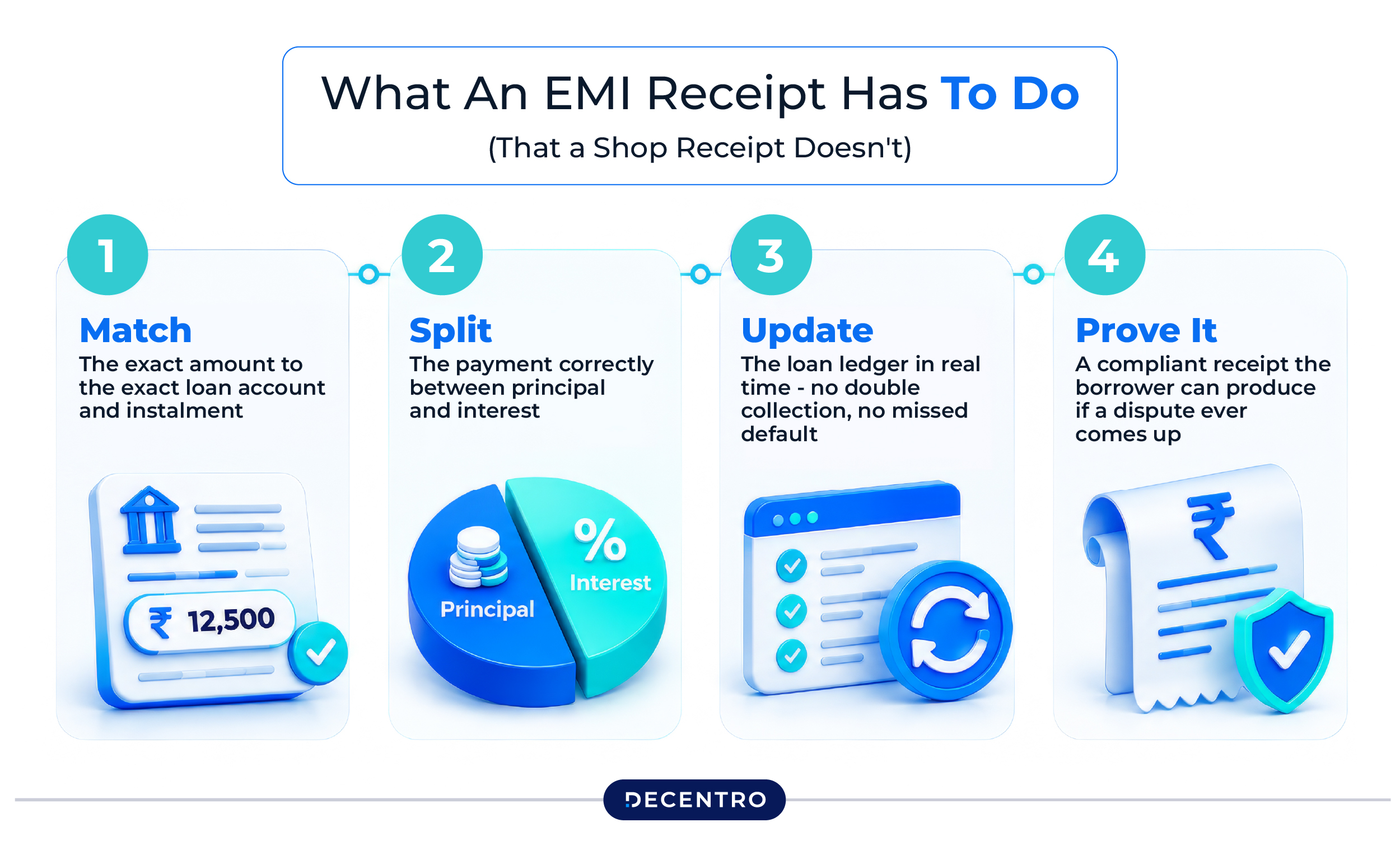
Think of a shopkeeper’s cash memo. When you buy groceries, you get a receipt showing what you paid, when, and for what. EMI receipting does the same thing for a loan repayment, except it also has to:
- Match the exact amount paid to the exact loan account and instalment number
- Split the payment correctly between principal and interest
- Update the loan ledger in real time so nobody double collects or misses a default
- Generate a compliant receipt the borrower can show as proof if a dispute ever comes up
For decades, in rural and semi-urban India, this happened on paper. A field agent visiting a borrower’s home or a self-help group meeting would collect cash, write a receipt by hand, and key the entry into a back-office system days later. Every step in that chain was a chance for error, delay, or fraud.
The EMI receipting process, step by step
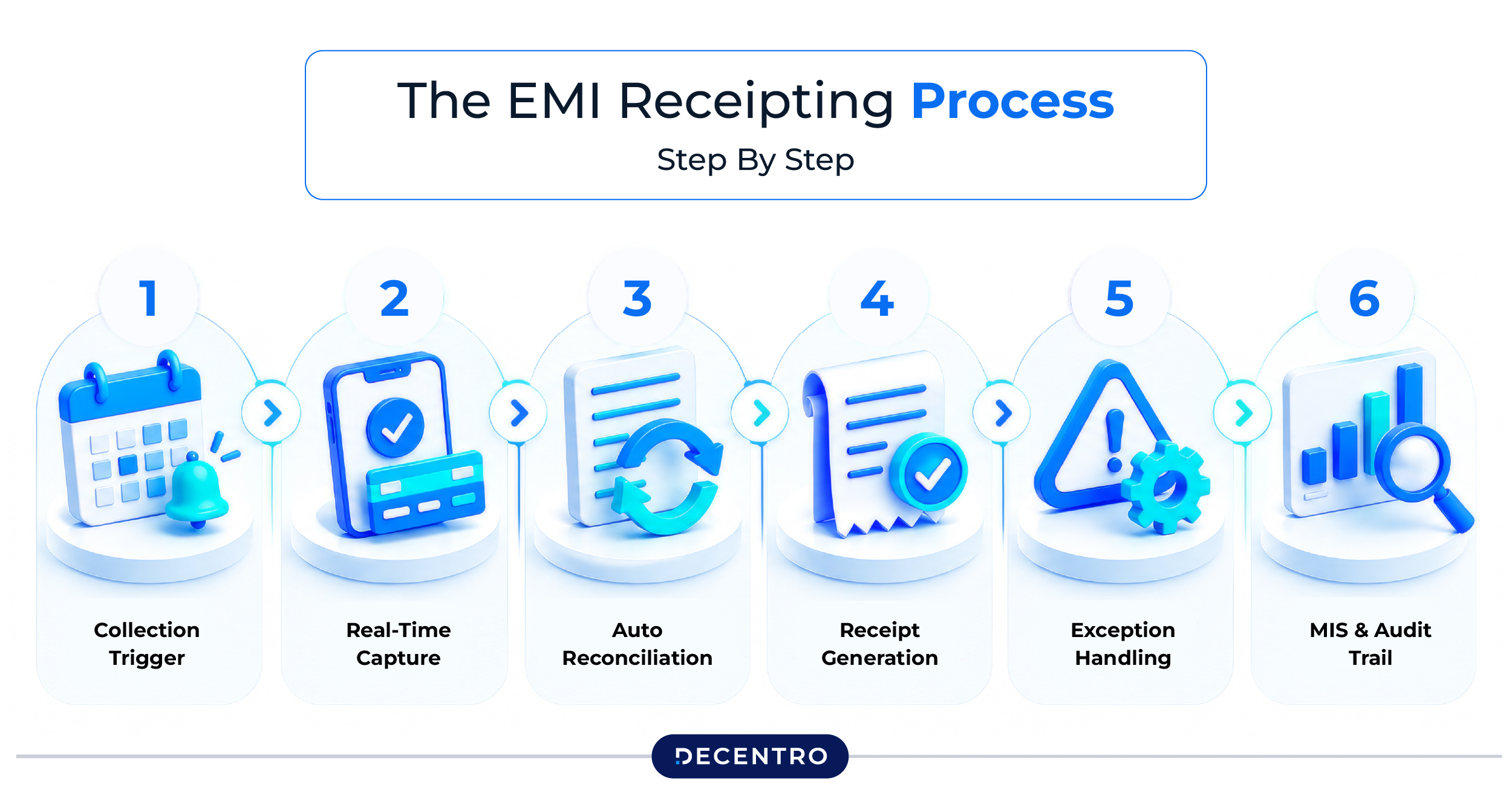
A modern microfinance receipting console typically works like this:
- Collection trigger. A payment is initiated, either by a field agent on a mobile app, a digital mandate such as eNACH or UPI Autopay, or the borrower paying directly through UPI or cash.
- Real-time capture. The console records the transaction against the correct loan account and instalment, timestamped and geo-tagged if collected in the field.
- Auto reconciliation. The amount is matched against the expected EMI, split into principal and interest, and posted to the loan ledger instantly, so there is no lag between collection and record.
- Receipt generation. A digital receipt, sent by SMS, app notification, or printed slip, is issued to the borrower immediately, showing the amount, date, outstanding balance, and a reference number.
- Exception handling. Partial payments, failed debits, or mismatches get flagged automatically and routed for follow-up, instead of sitting unnoticed in a spreadsheet.
- MIS and audit trail. Every receipt feeds into a dashboard that gives the lender and regulators, when needed, a complete, searchable history of collections.
This is what a good microfinance EMI receipting console is built to do at scale: hundreds of thousands of small-ticket transactions a day, each one needing the same rigour as a single large loan repayment.
Why the updates check matters as much as the receipt
A receipt only helps if it reflects the true, current state of the loan. That is why checking for updates, confirming that a payment has actually landed and reconciled, matters just as much as issuing the receipt itself.
Picture paying an electricity bill online and getting a “payment successful” message while the utility’s own system still shows you as unpaid. That gap between confirmation and reality is exactly what a robust console needs to close. In microfinance, where a large share of collections still happen through cash in hand or field agents, that gap has historically been wide, sometimes measured in days rather than seconds.
A well-designed collection console closes this gap through:
- Real-time status webhooks that update the loan management system the moment a payment clears
- Auto-retry logic for failed digital debits, so a bounced mandate does not silently turn into a missed EMI
- Dashboards that show collection officers which accounts are current, overdue, or in dispute, without waiting for end-of-day reconciliation
How to get your EMI receipt
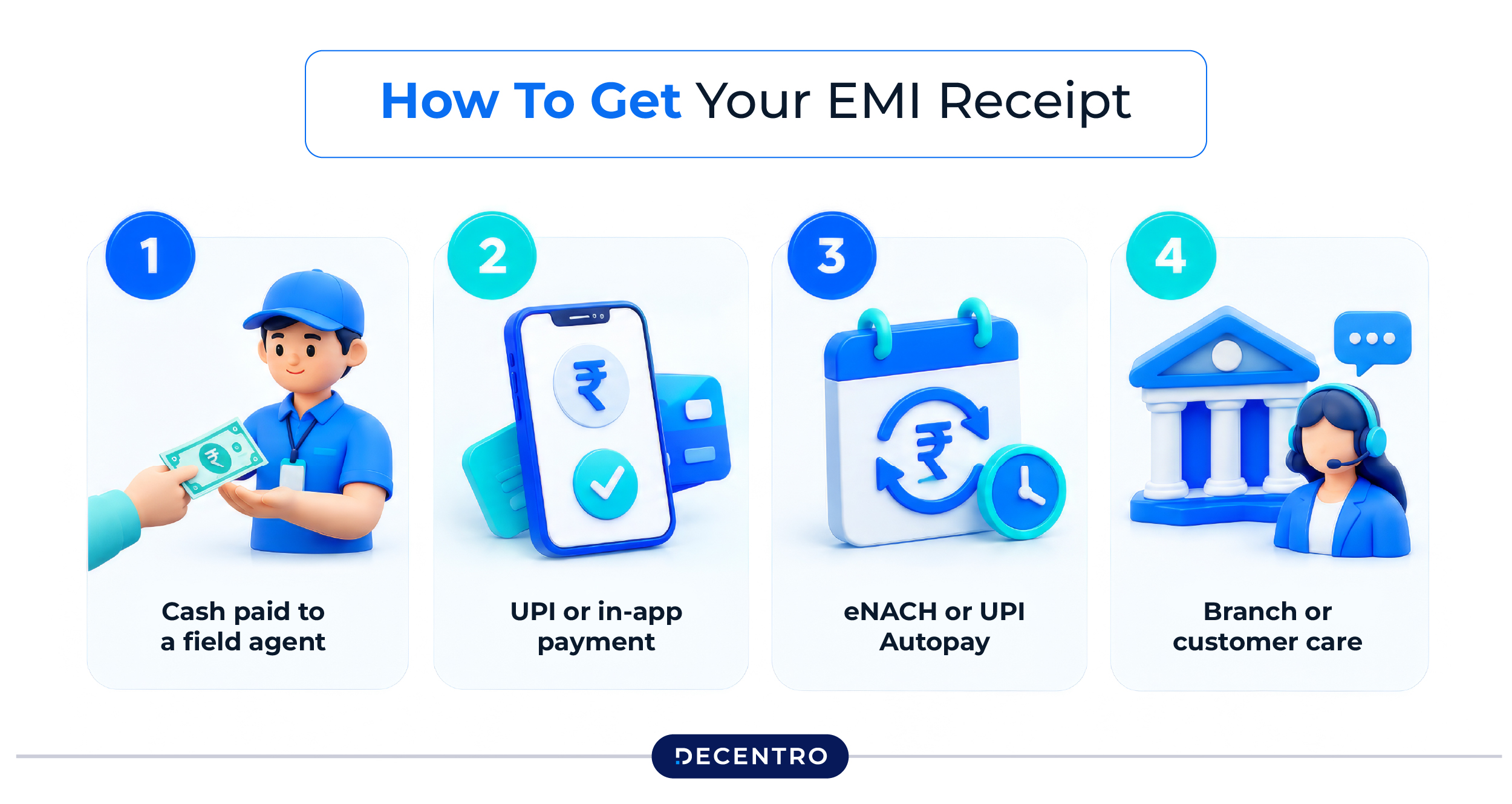
Confirming that a payment has reconciled is only half the job. The borrower also needs an easy way to get the proof. Depending on how the EMI was paid, a receipt usually reaches them in one of these ways:
- Cash paid to a field agent: The agent records the payment on a mobile app, and the borrower gets an SMS or printed slip straight away, showing the amount, date, outstanding balance, and reference number.
- UPI or in-app payment: A digital receipt or push notification arrives as soon as the payment clears, and it can also be downloaded from the lender’s app or borrower portal.
- eNACH or UPI Autopay: The pre-debit notification and post-debit confirmation required under RBI’s 2026 e-mandate framework form the payment trail, and the lender should also make a receipt available in the app or on request.
- Branch or customer care: Borrowers can ask for a duplicate receipt or a repayment statement by quoting their loan account number.
Whichever route is used, the borrower should check that the receipt matches the amount paid and that the outstanding balance has actually updated. If it has not, they can raise a query using the receipt’s reference number, which lets the lender trace the transaction quickly instead of relying on memory or a verbal claim.
The regulatory backdrop
This is not just an operational nice-to-have. Regulation has pushed hard in this direction.
RBI’s 2022 Microfinance Directions laid the foundation. Under the Reserve Bank of India (Regulatory Framework for Microfinance Loans) Directions, 2022, effective April 1, 2022, all collateral-free loans to households with annual income up to ₹3,00,000 are treated as microfinance loans, whether processed physically or digitally. Total loan repayment obligations for a household, across all loans, cannot exceed 50% of monthly household income, and pricing must be transparent and disclosed in a standardised format, with a board-approved fair practices code displayed at every office. This alone made accurate, auditable receipting essential, since a lender cannot prove compliance with income and repayment caps without a clean, real-time record of every rupee collected.
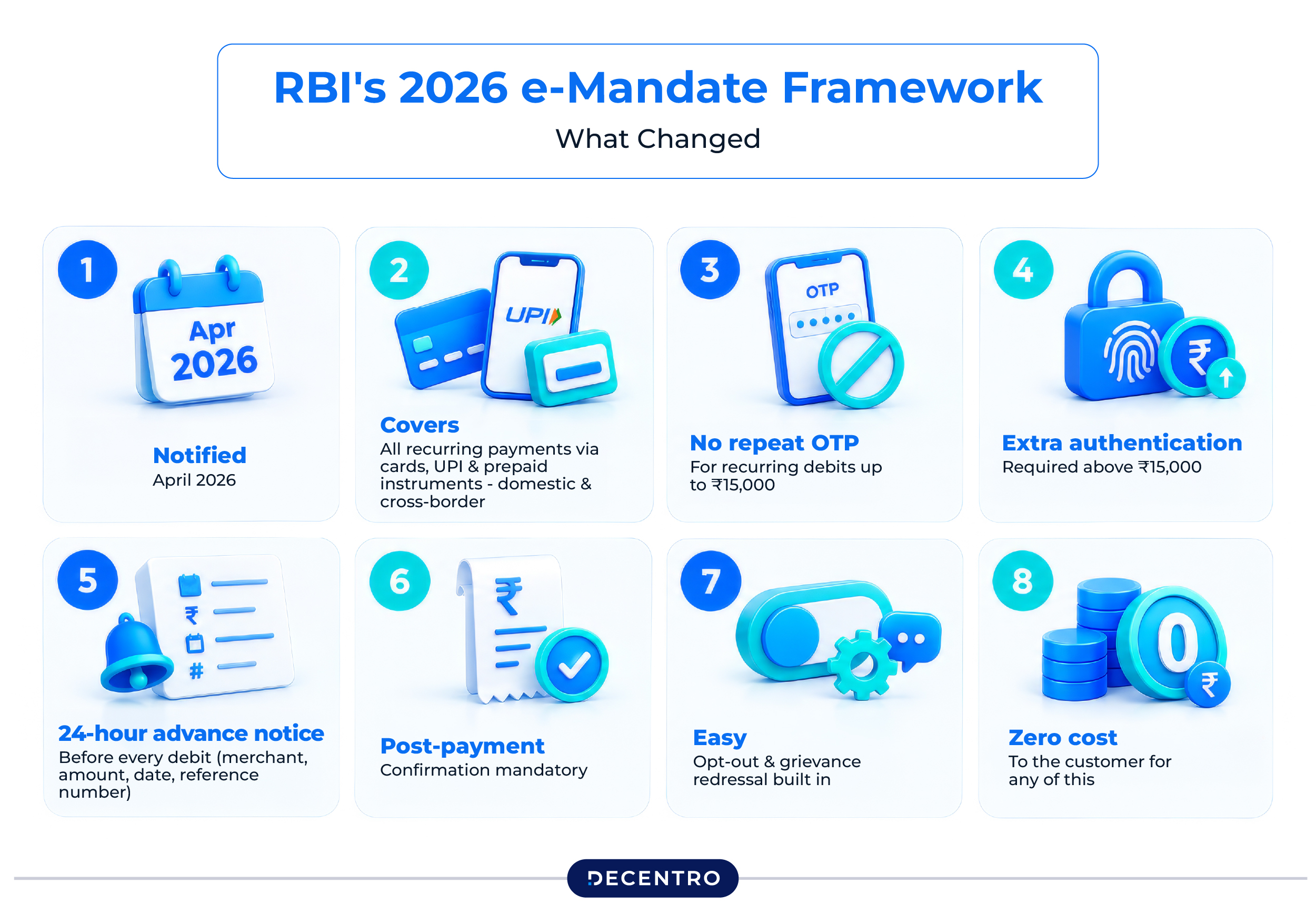
RBI’s Digital Payments, e-mandate Framework, 2026 goes further and is directly relevant to any lender using digital collection rails. Notified in April 2026, it consolidates existing e-mandate circulars and applies to all payment system providers processing recurring domestic and cross-border transactions through cards, UPI, and prepaid instruments. Some changes that hit collection consoles directly:
- Recurring debits up to ₹15,000 can now be processed without repeated OTP authentication, while higher amounts still need additional factor authentication.
- Businesses must send a pre-transaction notification at least 24 hours before every recurring debit, including merchant name, amount, date, and reference number.
- Post-transaction confirmations and a clear opt-out and grievance redressal mechanism are mandatory too, and none of this can be charged to the customer.
For EMI collections specifically, the shift toward digital mandates is well underway. Two rails dominate: UPI Autopay for speed and mobile-first, lower-ticket EMIs, and e-NACH for high-value, long-tenure loans with bank-validated mandates. Since NBFCs cannot access NACH directly, e-NACH mandates have to be routed through a sponsor bank before reaching NPCI. The scale is enormous. UPI Autopay alone processed more than 1.27 billion recurring mandates in November 2025.
What this means in practice is that a microfinance receipting console today has to be more than a ledger. It has to function as compliance infrastructure, generating the right notifications, at the right time, through the right channel, automatically.
Why this matters more in a stressed sector
Given the industry’s current headwinds, falling portfolios and rising indebtedness in pockets, along with the RBI cautioning NBFCs that microfinance loan performance needs close monitoring even as overall asset quality improves, clean receipting is not just about customer experience. It is risk management.
For lenders, accurate, real-time collection data is often the earliest warning signal for portfolio stress. If a console can flag a spike in failed debits or partial payments within hours instead of weeks, collections teams can step in before an account slides into default.
For borrowers, a transparent receipt is often their only proof of payment, which matters for people who may not have the financial literacy or paperwork trail to dispute a wrongful default listing with a credit bureau.
For regulators, it is the audit trail that proves a lender is following household income caps, fair practices, and mandate notification rules.
In a sector where trust between borrower and lender is the entire business model, EMI receipting functions as that trust mechanism.
Where the rest of the loan lifecycle fits in
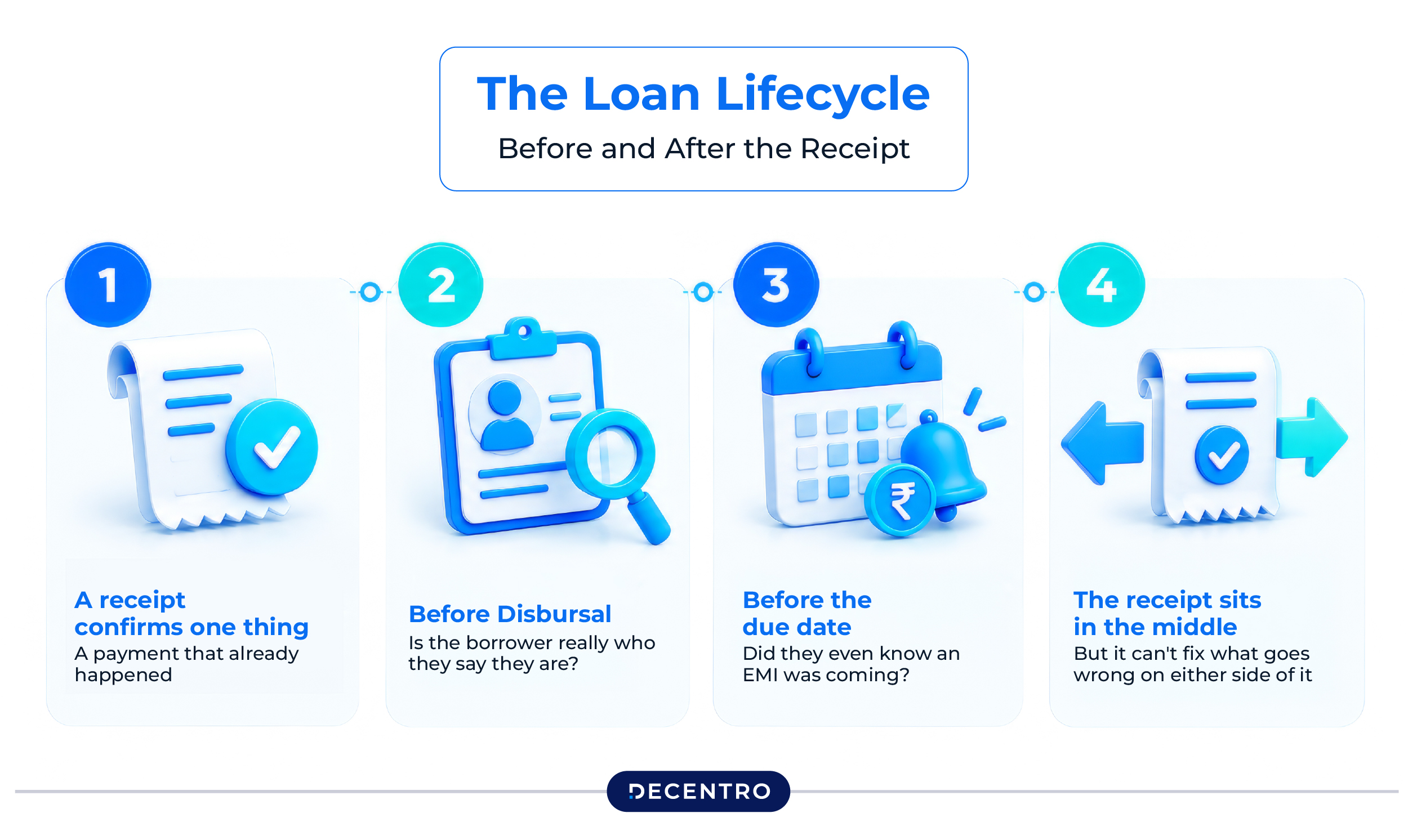
A receipt only confirms a payment that already happened. The two moments that decide whether that payment happens at all sit on either side of it: making sure the borrower is who they say they are before the loan is disbursed, and making sure they actually hear about their EMI before it is due.
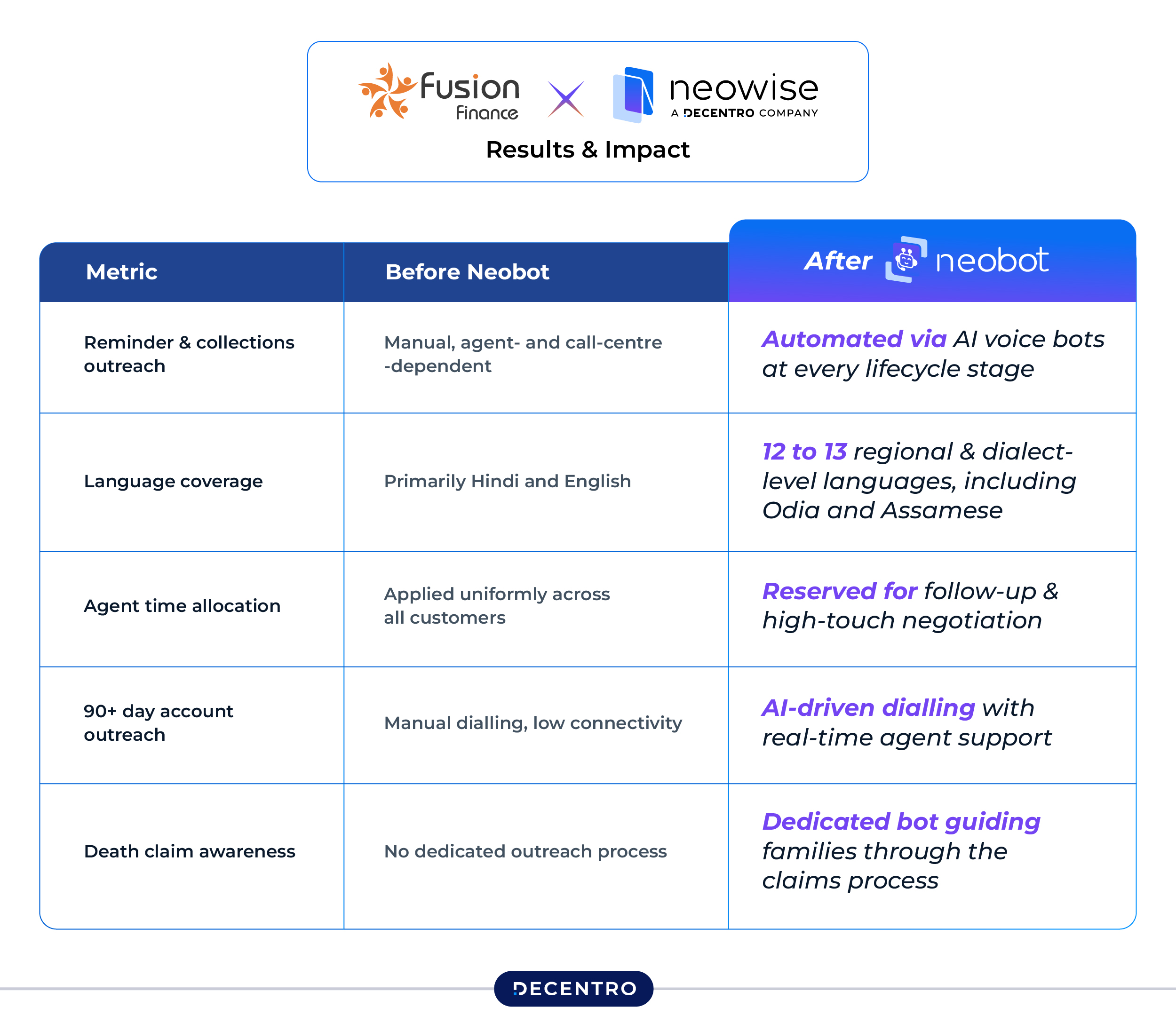
On the outreach side, Neowise, a Decentro company, tackles the second problem. Fusion Finance, a microfinance lender with over 32 lakh active borrowers across 22 states, was running collections through field agents and manual call centre calling, with coverage limited mostly to Hindi and English even though its borrowers spoke a dozen different regional languages at home. Working with Neowise’s NeoBot, Fusion Finance moved to AI voice bots covering every stage of the loan, from a welcome call after disbursal to pre-due reminders and settlement conversations, in 12 to 13 regional languages. Pre-due reminder calls scaled from 472 loans in June to over 17,500 in July, and results held up at that volume: connectivity rose from 65.89% to 84.87%, and promise to pay rose from 25.08% to 40.03%.
A receipting console can reconcile a payment perfectly, but it cannot make a borrower aware the payment was due in the first place. That is the gap this kind of automated, multilingual outreach closes.
On the onboarding side, the same RBI 2022 framework that governs receipting also requires lenders to assess household income and borrower identity correctly before a loan is even sanctioned.
Decentro’s KYC and onboarding APIs help here, pulling CKYC records, DigiLocker documents, and identity checks in real time so a lender can verify a borrower in seconds instead of days.
Decentro’s Scanner adds a fraud layer on top, running document and face verification with liveness checks to catch tampered IDs or duplicate applications before they enter the loan book. Get this stage wrong, and every receipt downstream is attached to a borrower record that was never properly verified.
Put together, these three layers- verified onboarding, reliable receipting, and multilingual borrower outreach- cover a loan from the first KYC check to the last EMI.
Conclusion
EMI receipting sounds like a small, administrative detail buried deep in loan operations. It is not. With India’s microfinance sector managing over ₹3 lakh crore across more than 10 crore accounts, under growing regulatory scrutiny and real portfolio stress, the accuracy and speed of receipting decide whether a lender can spot trouble early, keep borrowers confident, and stay compliant with the RBI’s evolving e-mandate and household income rules. But no receipting console works in isolation. It needs a borrower who was verified correctly at onboarding and reached effectively before the due date. Together, these pieces are what keep microfinance lending fair, auditable, and sustainable, loan after loan, EMI after EMI.