Compare India’s top microfinance companies and the software powering their collections. See rankings, AUM data, and what drives post-crisis recovery.

Top 10 Microfinance Software & Companies in India (2026)

A true blue millennial trying to engineer her full time-career around the world of content. How cliché is that?
Table of Contents

India’s microfinance industry is coming out of one of the toughest stretches in its history. Over-leveraged borrowers, state-level political disruptions, and tighter RBI guardrails pushed portfolio quality down through FY24 and FY25. By the January-March quarter of FY26, the industry’s gross loan portfolio finally grew again after seven straight quarters of contraction, settling near ₹2.77 lakh crore in outstanding portfolio, with delinquencies easing back toward pre-crisis levels.
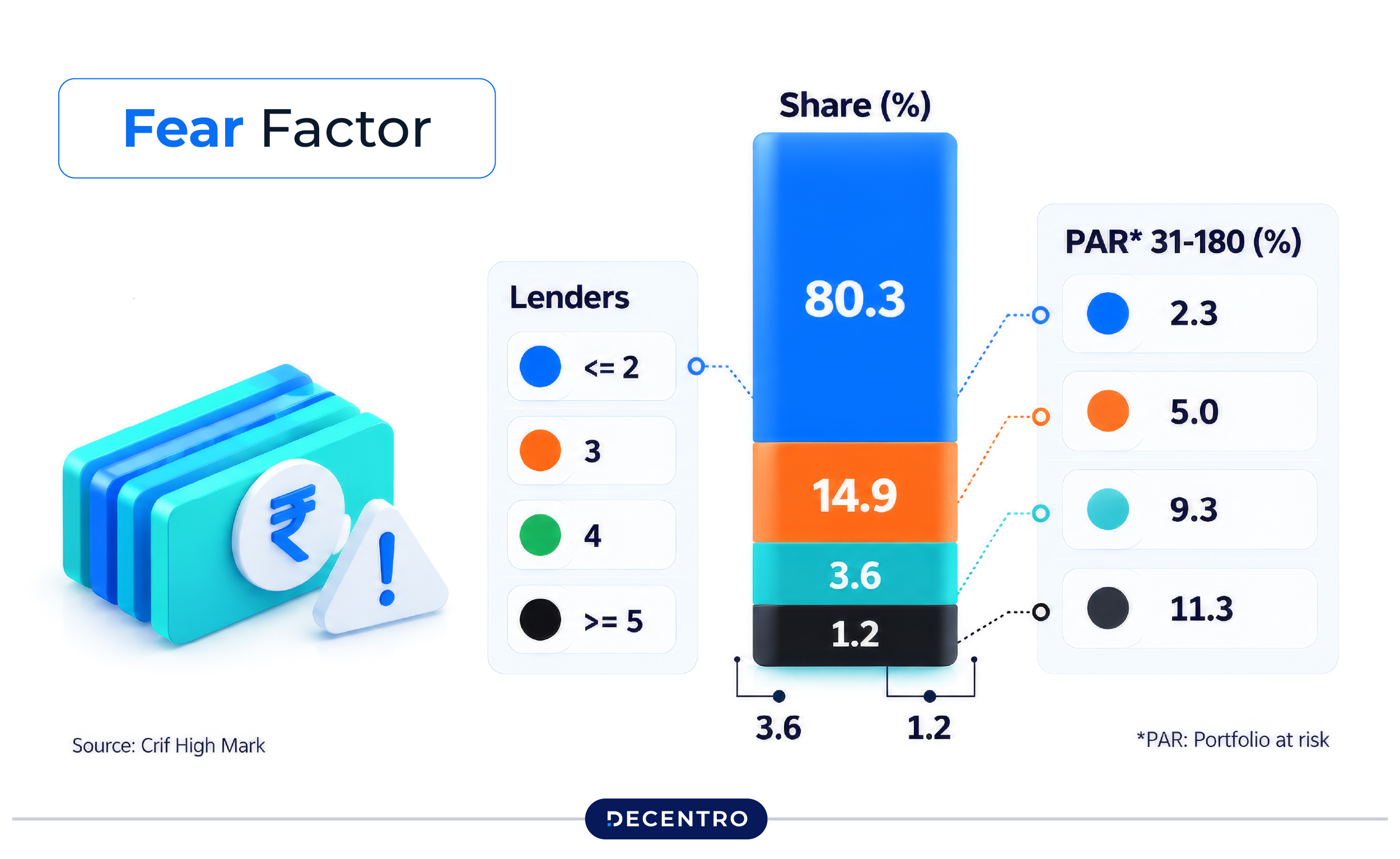
What got the sector here wasn’t better underwriting alone. It was collections. The microfinance companies that survived this cycle rebuilt how they track repayments, follow up with borrowers, and move money in and out of accounts every day. When you run a joint liability group model with lakhs of small-ticket, weekly or monthly repayments, your collections and payments infrastructure isn’t a back-office function. It’s the business.
A Quick Glance
| # | Company | Best For | Core Strength |
|---|---|---|---|
| 1 | Fusion Finance | Rural NBFC-MFI lending with a proven turnaround | Fastest post-crisis return to profitability |
| 2 | CreditAccess Grameen | Large-scale, diversified microfinance lending | India’s largest NBFC-MFI by portfolio |
| 3 | Muthoot Microfin | South India-focused group and secured lending | Backed by Muthoot Pappachan Group distribution |
| 4 | Satin Creditcare Network | Diversified rural finance (MFI + housing + MSME) | Multi-entity model with improving credit metrics |
| 5 | Spandana Sphoorty | Turnaround-stage microfinance lending | Aggressive balance sheet cleanup, rising collections |
| 6 | Asirvad Micro Finance | Gold-backed diversification within microfinance | Manappuram-backed capital support |
| 7 | Annapurna Finance | Unlisted, rural and tribal-focused microfinance | Strong access to international social funding |
| 8 | Belstar Microfinance | Muthoot-backed SHG and JLG lending | Strong parent-backed credit rating (CRISIL AA) |
| 9 | Arohan Financial Services | Eastern India microfinance leadership | Tech-enabled disbursal and collections |
| 10 | Ujjivan Small Finance Bank | Microfinance plus full banking services | Access to low-cost deposits (CASA) |
That’s the lens we used for this list. We reviewed microfinance companies operating in India today based on AUM, geographic reach, asset-quality trends, and how well each navigated the FY24-26 stress cycle. Here’s who made the cut.
Fusion Finance Limited

Fusion Finance, formerly Fusion Micro Finance, takes the top spot because it weathered the sector’s worst credit cycle in a decade and emerged profitable. Originally incorporated in 1994 and converted into an NBFC-MFI in 2014, Fusion runs unsecured group loans for rural women alongside a growing MSME book. After a difficult FY25 that included a net loss and an ₹800 crore rights issue, the company returned to profit in Q3 FY26 with ₹31.6 crore in net profit, driven largely by tighter collections execution.
As of December 2025, Fusion’s AUM stood at ₹6,876 crore across 1,537 branches and 23.4 lakh customers, with Uttar Pradesh as its largest market at an estimated 11% share. Management is targeting ₹10,000 crore in AUM by FY27.
Pros:
- Clear turnaround from loss to profit;
- deep rural penetration (93% of book);
- strong regional dominance in UP.
Cons:
- Heavy North and East India concentration;
- recent asset quality stress and a rights issue to shore up capital;
- a minor RBI penalty over a KYC lapse in 2026.
Top features:
- JLG lending plus a growing MSME vertical;
- cross-sale loans for existing customers;
- digital field tools for collections and onboarding.
Market share: About 11% of the Uttar Pradesh microfinance market, with national AUM of ₹6,876 crore as of December 2025.
CreditAccess Grameen Limited

CreditAccess Grameen is India’s largest microfinance institution by portfolio, holding a 6.9% share of the national market as of March 2025, with even stronger positions in Karnataka (23%), Maharashtra (19.3%), Tamil Nadu (10.5%), and Madhya Pradesh (9.8%). Karnataka’s 2025 ordinance targeting microfinance practices hit collections hard in its most concentrated state, pushing delinquencies up sharply through the year.
The recovery has been fast, though. By Q3 FY26, net profit had surged over 350% year-on-year to ₹252 crore, with margins and asset quality both stabilizing.
Pros:
- Largest scale among listed NBFC-MFIs;
- fastest post-crisis recovery among peers;
- strong parent backing from CreditAccess India B.V.
Cons:
- Roughly a third of AUM concentrated in Karnataka;
- return on equity still recovering;
- reported acquisition interest from larger banks.
Top features:
- JLG model with flexible repayment options;
- wide product suite across income generation,
- home improvement, and retail finance;
- strong treasury systems built for high-frequency collections.
Market share: 6.9% of India’s microfinance industry, the largest NBFC-MFI in the country by gross loan portfolio.
Muthoot Microfin Limited

Part of the Muthoot Pappachan Group, Muthoot Microfin is the second-largest NBFC-MFI in South India, with a 16% share of the Tamil Nadu market and leadership in Kerala. AUM reached ₹14,457 crore by mid-2026, up 18% year-on-year, with disbursements surging 49%. The company is actively diversifying, adding gold loan co-lending with parent Muthoot Fincorp and individual lending products to reduce dependence on unsecured group loans.
Pros:
- Strong group brand and distribution;
- Recent CRISIL rating upgrade to AA-;
- Fast-growing secured and individual lending lines.
Cons:
- Still mostly unsecured;
- Volatile quarterly profits;
- Rapid disbursement growth warrants close watching on asset quality.
Top features:
- JLG lending for rural women;
- Gold-backed co-lending with Muthoot Fincorp;
- Individual loan book that crossed ₹1,000 crore.
Market share: Second-largest NBFC-MFI in South India, with a 16% share of Tamil Nadu’s microfinance market.
Satin Creditcare Network Limited

Satin has built one of the more diversified rural finance businesses in the country. Consolidated AUM hit ₹15,275 crore as of March 2026, up 19% year-on-year, spread across 1,841 branches after nearly 400 new branch additions in a single year. Non-microfinance businesses, including housing finance and MSME lending through its subsidiaries, now make up around 16% of the group and are growing fast. Credit costs fell from 4.6% in FY25 to under 4% in FY26.
Pros:
- Clear diversification into housing finance and MSME lending;
- Improving credit costs and ROA;
- Disciplined borrower leverage caps.
Cons:
- Still trades at a valuation discount versus peers;
- UP and Bihar together account for over 40% of the JLG book.
Top features:
- Multi-entity structure spanning microfinance, housing, and MSME;
- Business correspondent services via Taraashna Financial Services;
- Presence across 29 states and nearly 100,000 villages.
Market share: One of the larger listed NBFC-MFIs by AUM, at ₹15,275 crore consolidated as of March 2026.
Spandana Sphoorty Financial Limited

Spandana’s last two years show how quickly a microfinance book can shrink when collections falter. AUM fell from ₹11,973 crore in March 2024 to under ₹4,000 crore by early 2026, driven by heavy write-offs and a deliberate pullback in disbursements to clean up the balance sheet. There are signs of stabilization: under new leadership, the company posted 11% quarter-on-quarter AUM growth and 99.4% collection efficiency in Q1 FY27, alongside a return to modest profitability.
Pros:
- Proactive balance sheet cleanup;
- improving collection efficiency in recent quarters;
- long operating history since 1998.
Cons:
- Sharp AUM contraction through FY24-26;
- continued consolidated losses;
- elevated cost-to-income ratio during the cleanup phase.
Top features:
- JLG loans for low-income rural women;
- recent NCD issuances to diversify funding;
- renewed focus on collection efficiency as the core lever.
Market share: AUM around ₹3,800-4,900 crore through FY26 and Q1 FY27, down sharply from its FY24 peak but still a recognized industry name.
Asirvad Micro Finance Limited

Asirvad, majority owned by gold loan major Manappuram Finance, was hit with an RBI order to halt disbursements in late 2024 over compliance lapses. Since then, it has leaned hard into diversification: gold-backed loans rose from under 8% of AUM to over 31% by March 2026. Manappuram has backed the recovery with over ₹1,500 crore in fresh capital across FY26, lifting Asirvad’s net worth to ₹1,901 crore.
Pros:
- Strong parent backing with repeated capital infusions;
- meaningful pivot toward secured,
- gold-backed lending;
- wide footprint across 26 states.
Cons:
- Faced a direct RBI action halting disbursements in 2024;
- Contributes a modest share of parent Manappuram’s overall AUM;
- Shifting away from pure microfinance.
Top features:
- Gold loan co-lending with Manappuram;
- Wide geographic footprint;
- Structured funding arrangements with banks.
Market share: About 10.65% of Manappuram Finance’s group AUM mix as of March 2026, positioning it among the mid-to-large NBFC-MFIs.
Annapurna Finance Private Limited

Annapurna is among the largest unlisted microfinance companies in India, built specifically around rural, tribal, and semi-urban households from its Bhubaneswar base. AUM stood at ₹10,439 crore as of December 2024, backed by a five-year CAGR near 28%. It has stayed active in global capital markets through the downturn, raising a $100 million social loan from Standard Chartered in early 2026, on top of a $109.5 million syndicated loan in 2024.
Pros:
- Strong historical growth versus industry median;
- Consistent access to international social funding;
- Recognised client protection standards.
Cons:
- Less frequent public disclosure as an unlisted company;
- Return on assets declined during the FY25 stress period.
Top features:
- Doorstep delivery model;
- Diversified products including solar and EV financing;
- CGFMU guarantee cover on a large part of its book.
Market share: One of the largest unlisted NBFC-MFIs in India, with AUM above ₹10,000 crore.
Belstar Microfinance Limited

Belstar is the microfinance arm of Muthoot Finance, which holds a 66.13% stake. Loan AUM reached ₹7,911 crore for the nine months ending December 2025, with Tamil Nadu accounting for over 42% of the book. The company filed a DRHP for a ₹1,300 crore IPO in 2024, though the listing has been pushed back amid sector-wide stress. It carries a CRISIL AA/Stable rating on the strength of its parentage.
Pros:
- Backed by Muthoot Finance’s balance sheet;
- Strong credit rating relative to standalone peers;
- Long operating history since 2013.
Cons:
- High concentration in Tamil Nadu;
- Repeatedly delayed IPO;
- Significant write-offs during FY25-26.
Top features:
- Micro and small enterprise loans alongside consumer, festival, and education loans;
- SHG-based lending model;
- Capital adequacy of 23.5% as of March 2026.
Market share: One of the top 10 NBFC-MFIs in India, with AUM in the ₹7,900-11,200 crore range through FY25-26.
Arohan Financial Services Limited

Arohan is the largest NBFC-MFI in Eastern India, a region that alone accounts for over a third of the country’s microfinance portfolio. Backed by the Aavishkaar Group, Arohan reported AUM of ₹6,308 crore as of December 2025 across 1,073 branches in 17 states, with nearly 70% of its book in West Bengal, Bihar, Odisha, and Jharkhand. The company filed for an IPO in 2026 targeting a ₹600 crore fresh issue. It was briefly placed under an RBI cease and desist order in late 2024 over disbursement practices, lifted within about 75 days after remedial steps.
Pros:
- Clear market leadership in Eastern India;
- Strong technology investment in disbursal and collections;
- No promoter dilution planned in its IPO.
Cons:
- Very high regional concentration in a historically volatile microfinance region;
- Faced a temporary RBI action in 2024;
- Almost entirely unsecured book.
Top features:
- Income-generating loans for underserved rural women;
- Technology-enabled disbursal and collections;
- Deep rural focus, with 64%+ of AUM in rural geographies.
Market share: The largest NBFC-MFI in Eastern India, with national AUM of ₹6,308 crore as of December 2025.
Ujjivan Small Finance Bank

Ujjivan began as a pure-play microfinance institution before converting into a small finance bank in 2017, and microfinance still runs deep in its book. Group loans made up roughly 45% of its ₹37,057 crore gross loan book as of Q3 FY26, making it one of the largest microfinance lenders in the country even as a licensed bank. Overall loans grew 26.6% year-on-year to ₹40,655 crore by FY26-end, with deposits crossing ₹45,661 crore. The RBI has pushed SFBs like Ujjivan to cut microfinance dependence before granting universal banking licences, and Ujjivan is responding with a push into housing, gold, and vehicle loans, targeting a 65-70% secured mix by FY30.
Pros:
- Access to low-cost deposits,
- Unlike pure NBFC-MFIs;
- Individual micro-banking loans outperform group loans on asset quality;
- Fast-growing secured book.
Cons:
- Still heavily dependent on group microfinance loans;
- RBI has flagged this concentration as a hurdle to universal banking;
- Group loan asset quality has lagged individual loans.
Top features:
- Dual microfinance model of group and individual loans;
- Full banking licence with deposit mobilization;
- Diversified secured products including affordable housing and gold loans.
Market share: One of the largest microfinance lenders in India by book size, with roughly ₹16,700 crore in group loans as of FY26.
What separates the winners from the rest
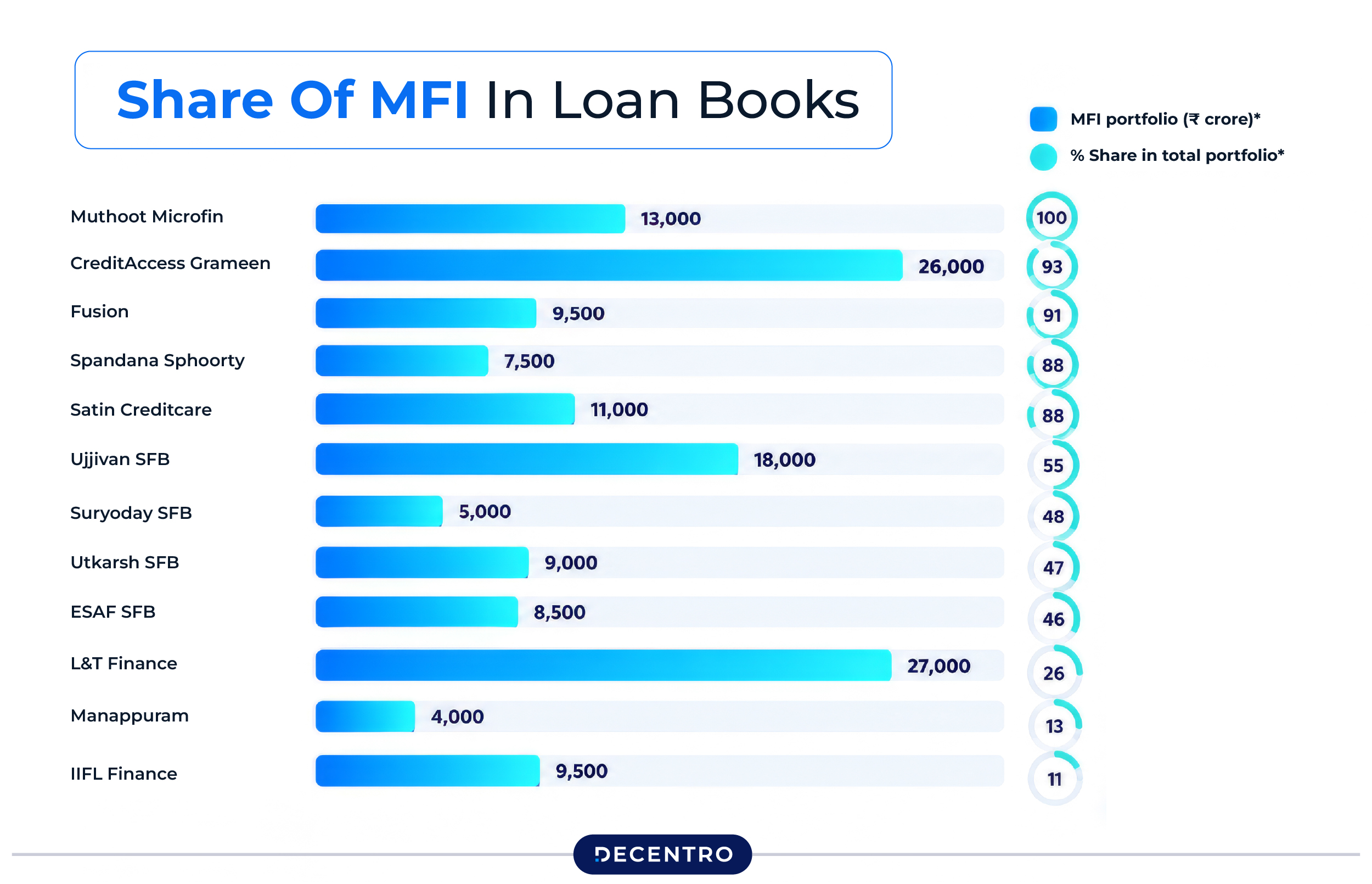
A pattern shows up quickly across this list. The microfinance companies that recovered fastest from the FY24-26 stress cycle, Fusion Finance, CreditAccess Grameen, and Satin Creditcare among them, treated collections as a core operating discipline rather than an afterthought. The ones still working through write-offs, like Spandana Sphoorty and Asirvad, got caught relying on manual, field-heavy collection processes when borrower stress hit multiple states at once.
That’s not a coincidence. In a lending model built on small tickets, high borrower volumes, and frequent repayment cycles, the gap between a healthy portfolio and a stressed one usually comes down to how fast a lender can spot early delinquency, reach the right borrower on the right channel, and settle that payment without friction. Manual, spreadsheet-driven collections simply don’t scale to millions of accounts.
Where Decentro fits into this picture
This is the gap Neowise, a Decentro company, was built to close. Neowise runs an AI-driven collections and recovery platform built for lenders operating at the scale Indian microfinance companies deal with daily, currently managing over ₹2,000 crore in annual AUM across 30+ lenders and more than 5 million loan accounts. Neowise AI voice bots helped Fusion Finance reach rural borrowers in 12+ languages, lifting connectivity to 85% and promise-to-pay to 40%.
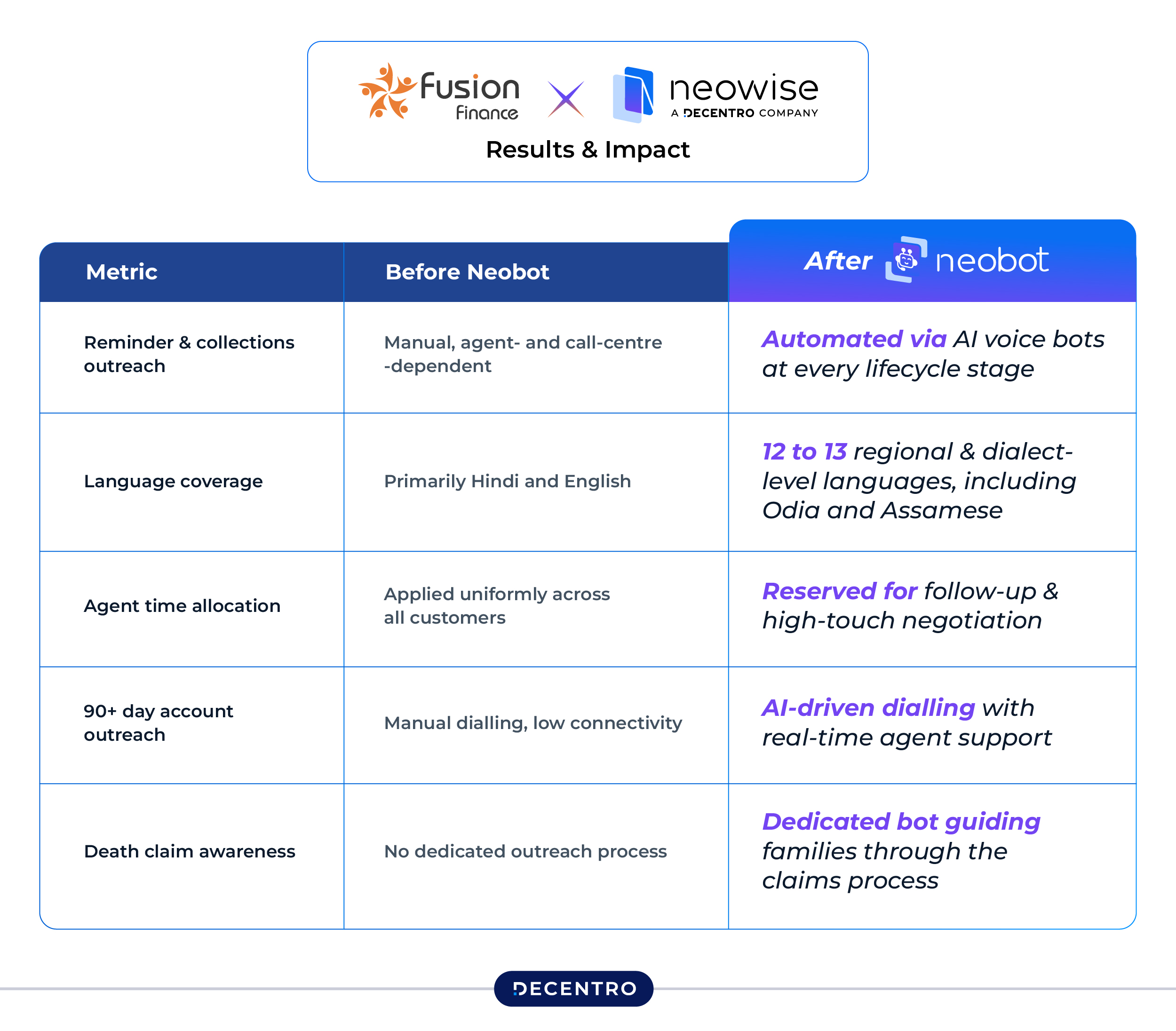
Because Neowise sits inside Decentro’s broader payments and banking infrastructure, microfinance companies get disbursal, repayment collection, and recovery workflows on one integrated stack instead of stitching together separate vendors. For an industry only just climbing out of its worst credit cycle in years, that kind of integration between payments and collections isn’t a nice-to-have. It’s what separates a microfinance company that scales sustainably from one that keeps writing off its book every few years.
If you’re building or scaling a lending business and want to see how collections-first infrastructure can protect your portfolio, Decentro and Neowise are worth a conversation.
Frequently Asked Questions
What are microfinance companies and how do they work in India?
Microfinance companies are lenders, mostly registered with the RBI as NBFC-MFIs, that offer small, collateral-free loans to low-income households, primarily women in rural and semi-urban areas. Most operate on a joint liability group model, where a small group of borrowers takes on shared responsibility for each other’s repayments, which keeps default rates low without requiring formal collateral.
Which is the largest microfinance company in India?
CreditAccess Grameen is currently the largest NBFC-MFI in India by portfolio, holding roughly 6.9% of the national microfinance market as of March 2025. Muthoot Microfin and Satin Creditcare Network follow as some of the other large players, though rankings shift quickly given how fast the sector is recovering post-FY26.
Are microfinance companies safe to borrow from in India?
Yes, as long as you’re borrowing from an RBI-registered NBFC-MFI, bank, or small finance bank. These lenders operate under RBI’s microfinance regulations, which cap household indebtedness, mandate risk-based pricing, and limit the number of lenders a single borrower can take loans from. It’s worth checking a lender’s RBI registration and reading the loan terms before signing up, since interest rates and fees can still vary meaningfully between institutions.
How are NBFC-MFIs different from small finance banks that also do microfinance?
NBFC-MFIs like Fusion Finance, CreditAccess Grameen, and Arohan are non-banking lenders that raise funds through borrowings, NCDs, and securitization, and their entire business is built around microfinance. Small finance banks like Ujjivan can also take retail deposits, which gives them access to lower-cost funding, and most are actively diversifying beyond microfinance into secured lending as the RBI pushes them toward a more balanced loan mix.