Lxme serves 1M+ users. Learn how Decentro’s DigiLocker KYC and bank account verification turned a multi-step onboarding into one guided flow.

How Lxme Cut KYC Friction for 1M+ Women Investors with Decentro

A true blue millennial trying to engineer her full time-career around the world of content. How cliché is that?
Table of Contents
Building India’s first financial platform exclusively for women meant Lxme had to solve a problem most fintechs don’t face in the same way: getting women who are often new to formal investing through KYC and account verification without losing them along the way. Decentro’s UIStreams and Bytes suite turned that multi-step compliance journey into a single, guided flow.
The Opportunity and Its Onboarding Challenge
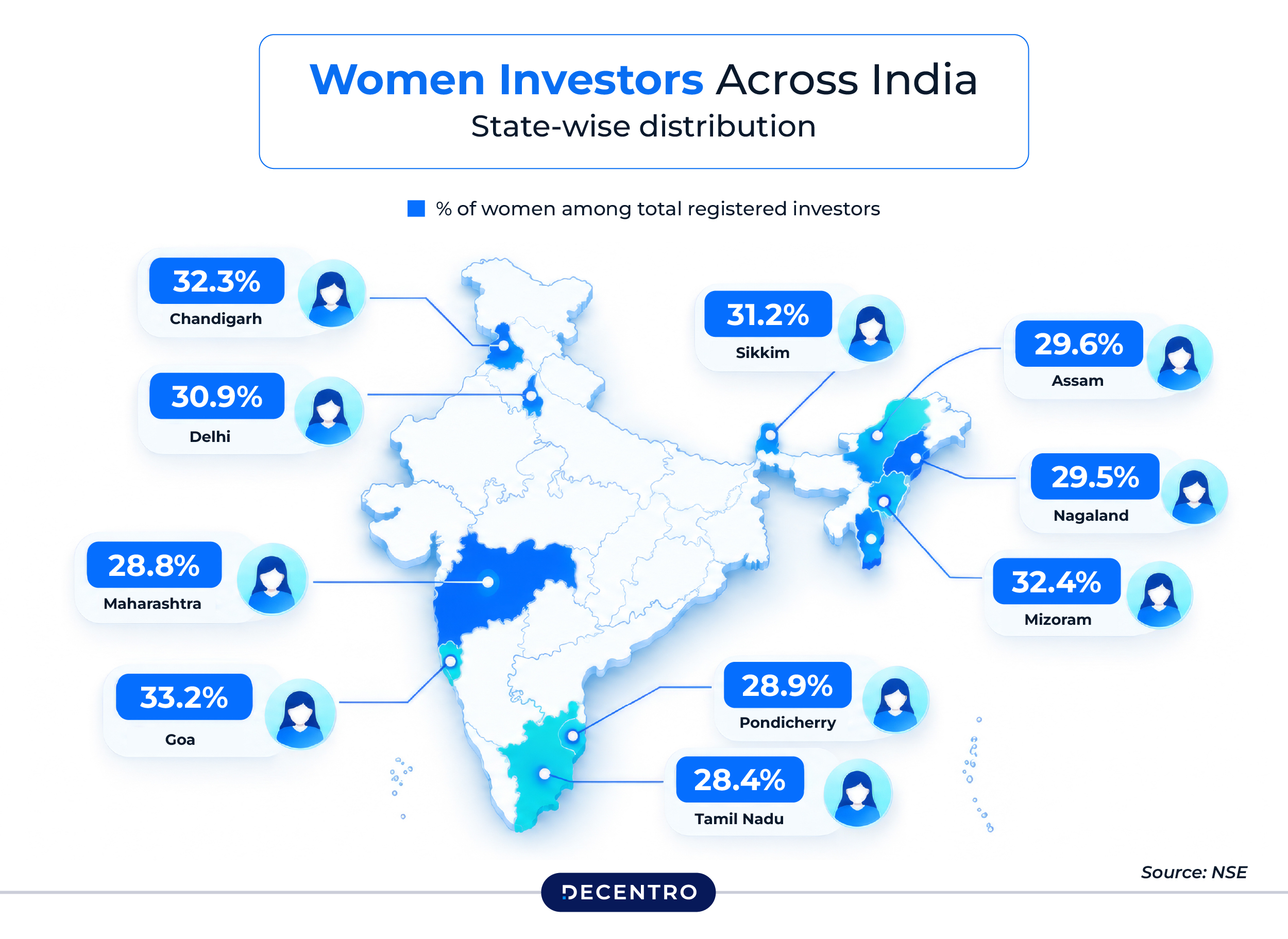
India’s female workforce has crossed 280 million, and women in the country control over $46 billion in fixed deposits alone. But financial literacy among women still lags behind men, and that gap shapes who comes to Lxme. Many users arrive making their first formal investment decision, so Lxme’s role goes beyond providing a product: it has to give each woman the confidence to begin. Onboarding is the first moment of that support. Every extra document upload, every redirect to find a bank statement, every stalled verification step is a place where a first-time investor can lose confidence and leave.
Traditional multi-step onboarding made this harder. A new user needs her identity verified and her bank account confirmed before any investment can be linked to it. Doing this manually, or through disconnected point solutions, meant multiple redirects and a fragmented experience for the audience Lxme exists to empower.
About Lxme

India’s First Financial Platform for Women
Founded in 2020 by Priti Rathi Gupta and co-founded by Ridhi Kanoria Doongursee, Lxme began as an app for managing investments and financial planning, and was rebuilt in 2021 around financial education. Today Lxme is a financial empowerment platform and community built for women, where they learn, ask questions, and grow their wealth through peer conversations, expert resources, and expert-backed financial products. The platform now serves over one million users, offering mutual funds, fixed deposits, and personal loans designed around women’s financial needs at different life stages.
For a platform whose purpose is to make finance feel less intimidating and more empowering, a bureaucratic onboarding process would have worked against its mission.
The Challenges
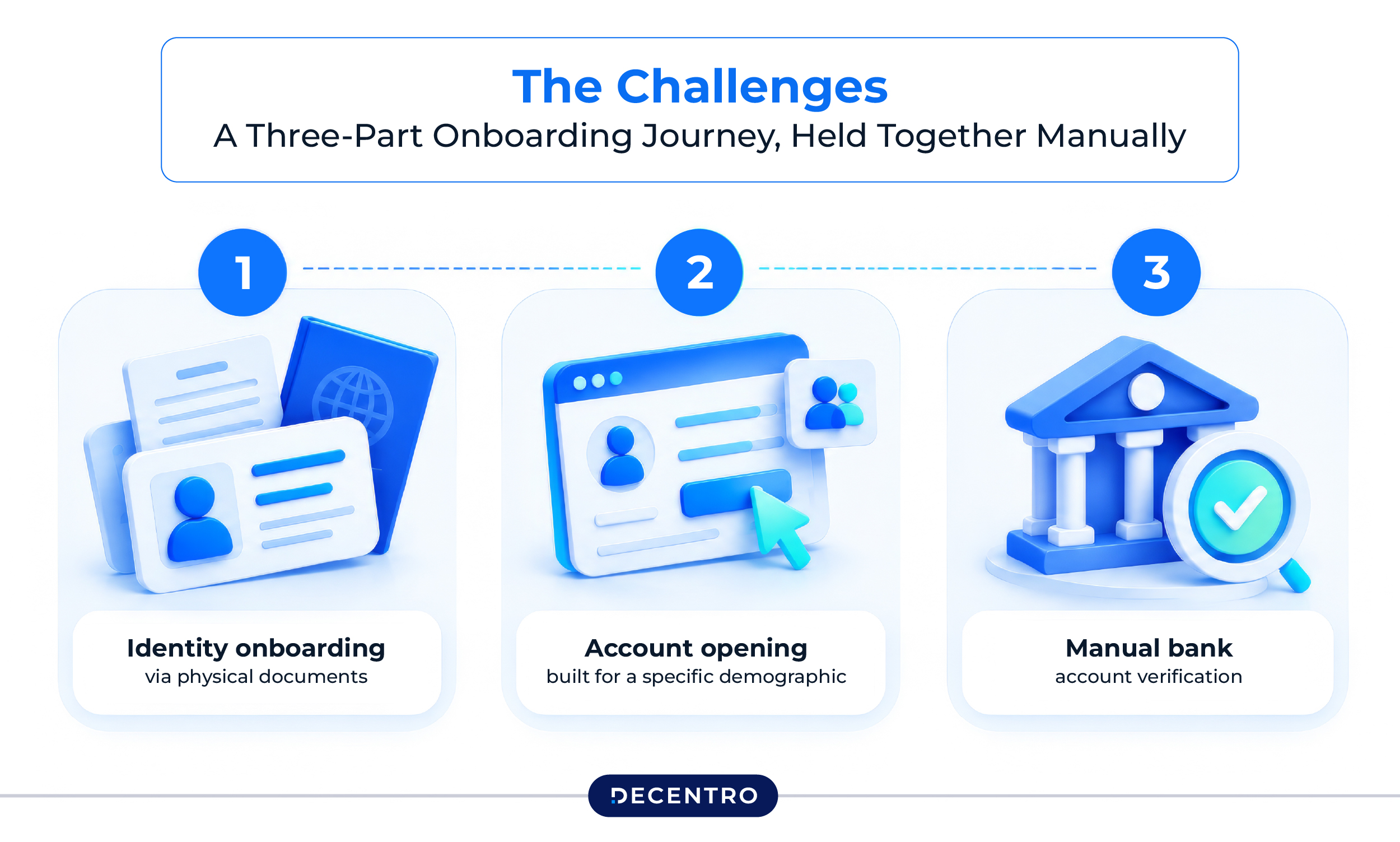
A Three-Part Onboarding Journey, Held Together Manually
Lxme needed to solve three verification and data challenges at once, each with its own friction points:
- Identity onboarding via physical documents. Traditional KYC required users to find, photograph, and upload physical identity documents. That is a slow step, and one that is more likely to cause drop-off among first-time investors who aren’t used to the process.
- Account opening built for a specific demographic. Opening an investment account for women, many stepping into formal investing for the first time, meant the KYC flow couldn’t afford to be confusing or spread across too many screens. Complexity at this stage reads as a barrier, not a formality.
- Manual bank account verification. Before linking any investment or payout to a user’s bank account, Lxme needed to confirm the account was active and genuinely hers. Done manually, that check adds delay and leaves room for mismatched or fraudulent account linkages.
The Solution
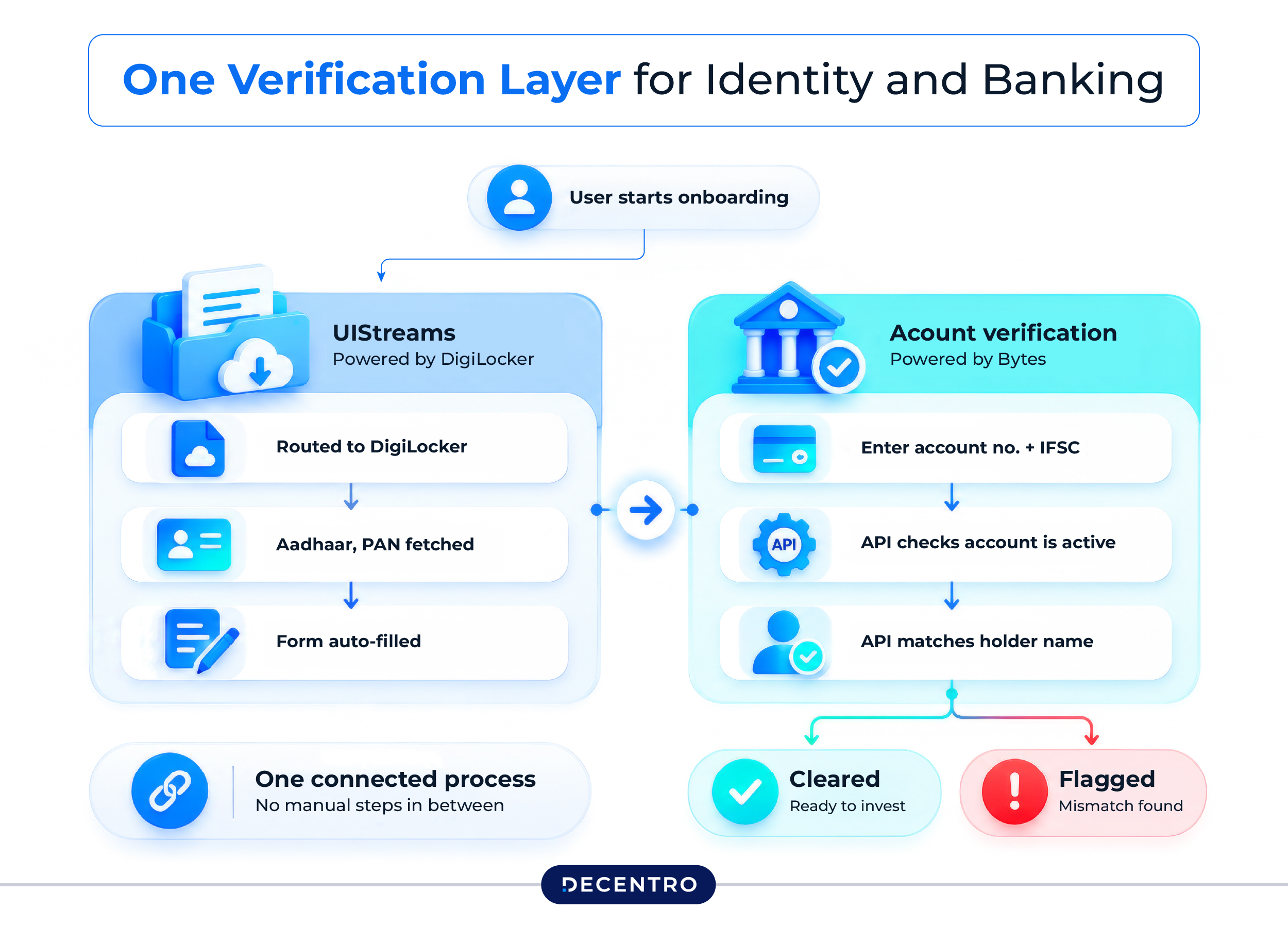
One Verification Layer for Identity and Banking
Lxme integrated two of Decentro’s modules into a single connected onboarding flow: UIStreams for DigiLocker-based identity onboarding, and Bytes for Account Verification for bank account checks.
UIStreams, powered by DigiLocker
Instead of manual document upload, users complete identity verification by pulling documents straight from their DigiLocker account, all within Lxme’s own onboarding screen.
- User starts onboarding and is routed to DigiLocker in the same flow
- Identity documents (Aadhaar, PAN, etc.) are fetched directly from the government-linked repository
- Verified identity data fills in the account-opening flow automatically
- No photographing, scanning, or manually uploading documents
Account Verification
Before any account is cleared for investment, the linked bank account gets verified.
- User enters bank account number and IFSC code
- API confirms the account is active and matches the account holder’s name
- Verified accounts are cleared for investment; mismatches get flagged right away
Together, these modules run as one connected background process instead of separate manual steps, so women can focus on their financial goals rather than paperwork.
Business Stakes
Why Onboarding Friction Costs More With a First-Time-Investor Audience
For a platform built to empower women on their financial journey, every point of friction in onboarding works directly against the mission. Decentro’s stack addressed two points effectively:
- Drop-off among first-time investors. Users who are new to formal investing are the most likely to abandon onboarding at the first sign of a confusing or multi-step process. DigiLocker-based onboarding removes the biggest single point of friction: document upload.
- Fraudulent or mismatched account linkage. Investing in, or paying out to, an unverified bank account creates fraud exposure and operational cleanup, a cost that grows as user volume grows. Verifying every account also protects the women Lxme serves and their hard-earned savings.
Results & Impact
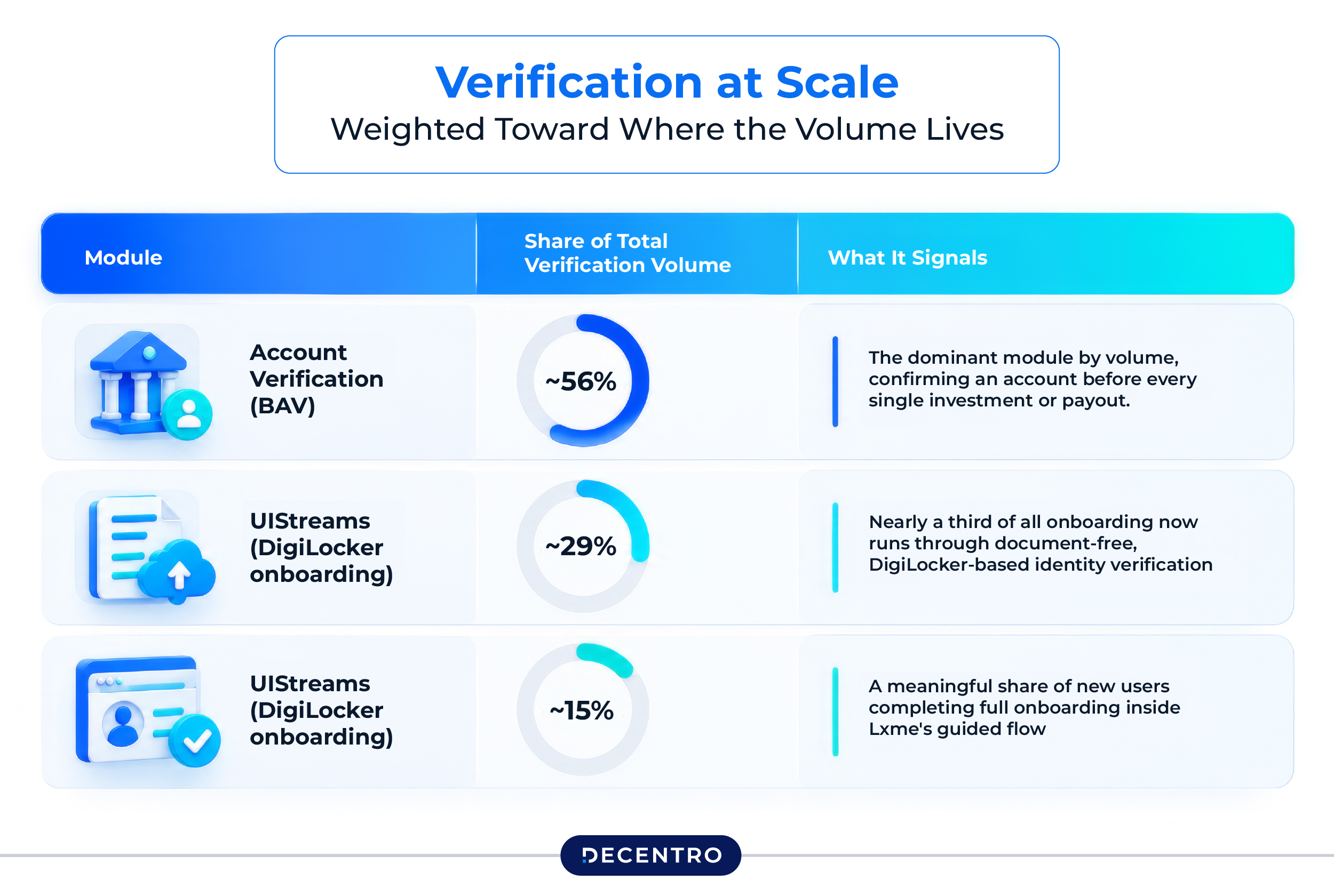
Verification at Scale, Weighted Toward Where the Volume Lives
| Module | Share of Total Verification Volume | What It Signals |
| Account Verification (BAV) | ~56% of all checks | The dominant module by volume, confirming an account before every single investment or payout |
| UIStreams (DigiLocker onboarding) | ~29% of all checks | Nearly a third of all onboarding now runs through document-free, DigiLocker-based identity verification |
| UIStreams (general onboarding flows) | ~15% of all checks | A meaningful share of new users completing full onboarding inside Lxme’s guided flow |
Voice of the Customer
At Lxme, our mission is to empower women on their financial journey, many of whom are taking their first step toward financial independence. That means onboarding cannot feel like a compliance hurdle; it has to feel seamless and supportive. By integrating Decentro’s DigiLocker and verification APIs into our flow, we delivered an experience that reflects Lxme’s promise: finance made simple, trustworthy, and empowering for women.
Ridhi Doongursee, Co-founder, Lxme
In Closing
Verification Built Around the User It Serves
Lxme’s mission is to empower women to take charge of their finances, starting with a first step that feels easy and confident. That depends on an onboarding experience that doesn’t undercut the promise with friction. By combining Decentro’s DigiLocker-based UIStreams and bank account validation into a single onboarding layer, Lxme turned identity verification and account confirmation into a background process rather than a barrier.
This mirrors results Decentro has delivered elsewhere in the fintech ecosystem, including 200% growth in DigiLocker adoption at Olyv and integrations with platforms like BookMyForex, BimaPay, and Volopay. API-first verification at the point of onboarding keeps proving to be one of the highest-ROI infrastructure investments a fintech platform can make.
Decentro’s verification infrastructure processes hundreds of thousands of validations daily, serving partners across lending, remittances, neo-banking, and investment platforms.
Ready to streamline your onboarding?